Customer GT3 cars
Every entry is a series-derived GT3 car, so eight manufacturers share one grid under Balance of Performance.

Germany’s leading touring car championship: two races every weekend, eight manufacturers on the same GT3 grid, and success ballast for anyone who dares to reach the podium.
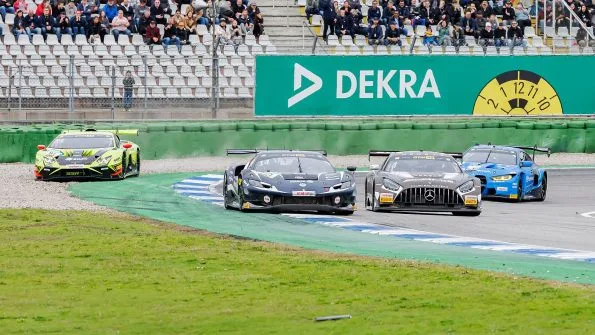
The DTM is Germany’s leading touring and GT car championship, promoted by ADAC. Since 2021 it has run to Group GT3 regulations, putting series-derived cars from eight manufacturers on the same grid under Balance of Performance. Every event carries two qualifying sessions and two races, and podium finishers take success ballast into the next race.
The Deutsche Tourenwagen Meisterschaft was founded in 1984 as a German national championship for production-based touring cars. It grew into one of the most watched series in Europe, drew works entries from Mercedes-Benz, BMW, Audi, Opel and Alfa Romeo, and collapsed in 1996 when costs outran the manufacturers’ appetite.
The name returned in 2000 as the Deutsche Tourenwagen Masters — same three letters, different rulebook. The cars were now silhouette racers: purpose-built machines wearing production bodywork. That approach hardened into the Class 1 regulations, which ran with naturally aspirated V8s and then, from 2019, turbocharged four-cylinder engines.
When Class 1 ended, the series switched to Group GT3 cars for 2021, trading bespoke prototypes for machinery customers can actually buy. The ITR was dissolved in December 2022 and ADAC has promoted the championship since.
A national championship that runs customer GT3 cars, twice a weekend, with the podium actively penalised.
Every entry is a series-derived GT3 car, so eight manufacturers share one grid under Balance of Performance.
Each event runs two qualifying sessions and two races, and both qualifying results pay championship points.
Podium finishers carry extra weight into the next race and shed it the moment they finish off the podium.
Both races launch from a rolling start rather than a standing grid, a change introduced with the GT3 era.
Two sessions, one per race. The top three in each score 3-2-1 championship points.
55 minutes plus one lap from a rolling start, with one mandatory pit stop inside a set window.
Same length and start procedure, but two mandatory stops, each in its own window.
A stop taken cheaply under a safety car or full-course yellow does not count toward the mandatory requirement.
| Pos | Points | Pos | Points |
|---|---|---|---|
| 1st | 25 | 9th | 7 |
| 2nd | 20 | 10th | 6 |
| 3rd | 16 | 11th | 5 |
| 4th | 13 | 12th | 4 |
| 5th | 11 | 13th | 3 |
| 6th | 10 | 14th | 2 |
| 7th | 9 | 15th | 1 |
| 8th | 8 |
Points are awarded in every race, so a single weekend can swing a championship by more than two Formula 1 wins.
| Round | Event | Circuit | Date |
|---|---|---|---|
| 01 | Spielberg | Red Bull Ring, Austria | 25–26 April |
| 02 | Zandvoort | Circuit Zandvoort, Netherlands | 23–24 May |
| 03 | Lausitzring | Lausitzring, Germany | 20–21 June |
| 04 | Norisring | Norisring, Nuremberg, Germany | 4–5 July |
| 05 | Oschersleben | Motorsport Arena Oschersleben, Germany | 25–26 July |
| 06 | Nürburgring | Nürburgring, Germany | 15–16 August |
| 07 | Sachsenring | Sachsenring, Germany | 12–13 September |
| 08 | Hockenheim | Hockenheimring, Germany | 10–11 October |
Last updated: 6 September 2026, after six of eight rounds. Verify current dates with the official DTM calendar.
The Deutsche Tourenwagen Meisterschaft launches as a national series for production-based touring cars.
Rising costs and thinning entries end the original championship after the ITC season.
The DTM returns with silhouette racers built to a common set of rules.
The regulations that would define the next sixteen years, run with naturally aspirated V8 engines.
Class 1 switches to turbocharged four-cylinder engines in its final phase.
The series adopts customer Group GT3 cars and rolling starts.
The ITR is dissolved in December and ADAC becomes the promoter.
Ayhancan Güven beats Lucas Auer to the title by four points across sixteen races.
Works entries from Mercedes-Benz, BMW, Audi, Opel and Alfa Romeo turned a national series into a European draw.
The name returned on purpose-built cars wearing production bodywork, rebuilt around cost control.
Sixteen seasons of bespoke prototypes and a Mercedes–Audi–BMW duel that defined the modern DTM.
Turbocharged four-cylinder engines arrived just as the manufacturers began to leave.
Customer cars, Balance of Performance and eight manufacturers sharing one grid.
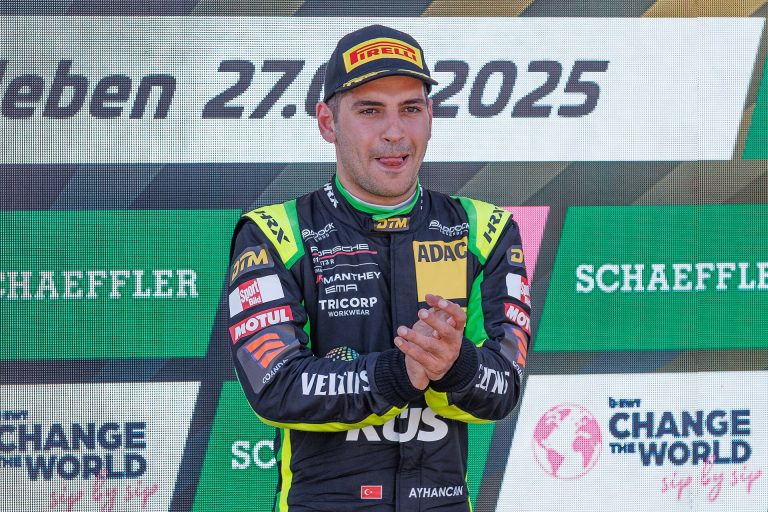
2025 DTM Champion · Manthey EMA · Porsche 911 GT3 R
The benchmark of the Mercedes era and the only driver to win five DTM titles.
Three championships in four seasons made him the defining driver of the Class 1 years.
Took the 2025 crown for Manthey EMA in a Porsche 911 GT3 R, four points clear at the finish.
Lost the 2025 title by four points and returned with Mercedes-AMG Team Landgraf.
Leads the 2026 standings for Winward Racing after the first six rounds.
One point off the 2026 lead for Manthey Racing, the closest title fight on the grid.
Carrying Aston Martin's 2026 campaign with Comtoyou Racing.
The former Formula 1 racer now driving a McLaren for Dörr Motorsport.
Costs outrun the manufacturers and the original championship ends, leaving the name dormant for four years.
A new rulebook and a new promoter bring the DTM back, this time as the Masters.
Manufacturer withdrawals leave the prototype formula without a grid and force a complete reset.
Adopting customer cars reopens the series to teams and manufacturers who could never fund a bespoke prototype.
ADAC takes the promoter's role in December, ending the organisation that had run the series since its revival.
Güven and Auer take the championship to the final race, decided by less than a single podium.
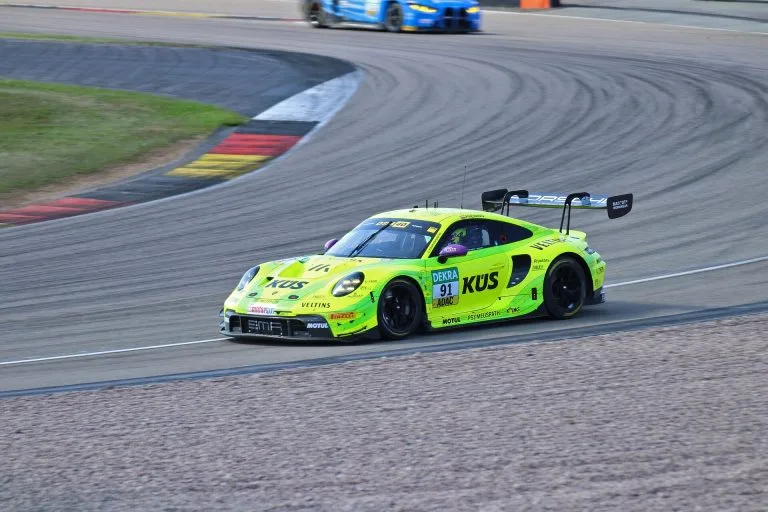
2025 DTM Teams’ Champion · Porsche 911 GT3 R
The DTM is Germany's leading touring and GT car championship. It is promoted by ADAC and has run to Group GT3 regulations since 2021, with two races at every event.
ADAC, Germany's national automobile club, which took over the series after the ITR was dissolved in December 2022.
Series-derived Group GT3 cars. The 2026 grid fields Aston Martin, BMW, Ferrari, Ford, Lamborghini, McLaren, Mercedes-AMG and Porsche.
Two qualifying sessions and two races. Each race runs 55 minutes plus one lap from a rolling start; Saturday has one mandatory pit stop and Sunday has two.
The top 15 finishers in each race score 25-20-16-13-11-10-9-8-7-6-5-4-3-2-1. The top three in each qualifying session add 3-2-1, so a perfect weekend is worth 56 points.
Extra weight carried into the next race by drivers who finished on the podium. It is removed as soon as a driver finishes off the podium, and sits on top of the Balance of Performance adjustments.
It is the continuation of the name, not the ruleset. The original Deutsche Tourenwagen Meisterschaft ran from 1984 to 1996; the series was reborn in 2000 as the Deutsche Tourenwagen Masters and has changed car regulations several times since.
Bernd Schneider, with five championships. René Rast is next with three.
Ayhancan Güven, driving a Porsche 911 GT3 R for Manthey EMA, by four points from Lucas Auer. Manthey Racing took the teams' championship.
Eight rounds and sixteen races, opening at the Red Bull Ring in April and finishing at Hockenheim in October.
The DTM is a national championship at heart. Seven of the eight 2026 rounds are held in Germany, with Zandvoort in the Netherlands and the Austrian opener the exceptions.
No. Unless a product page explicitly states otherwise, Kozmozracing is an independent store and is not affiliated with or endorsed by the DTM, ADAC, any team or driver.
Independent fan guide: Formats, teams and regulations can change. Verify current sporting information with the DTM and ADAC. Championship, team and driver names belong to their respective rights holders.
No products are assigned to DTM yet. Add products to this series in the product editor.