Entry point to the F1 pathway
The first internationally standardised rung after karting, F4 and Formula Regional at which drivers race full Grand Prix weekends.

The entry point to Formula 1's official pathway — an identical Dallara chassis for every team, a compact two-race weekend, and the first rung where drivers race full Grand Prix weekends alongside F1 and F2.
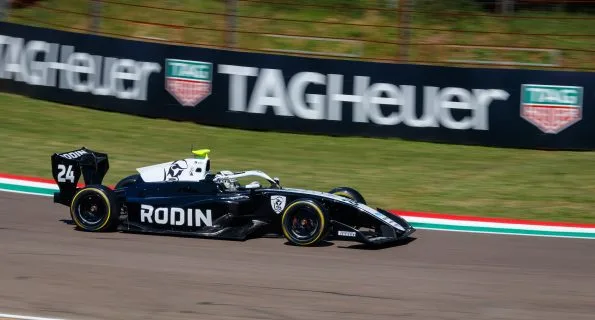
FIA Formula 3 is the third tier of the FIA's international single-seater pyramid and the first step at which drivers race full Grand Prix weekends alongside Formula 1 and Formula 2. It is a single-make series — every competitor uses an identical Dallara chassis and Mecachrome V6 engine — so the cars are equal and results come down to the driver and the team. The championship sits directly below FIA Formula 2 on the pathway to Formula 1.
“Formula Three” was adopted by the FIA in 1950 as a lightweight, 500cc-engined class, with Britain among the first countries to run national championships carrying the name.
The modern FIA Formula 3 Championship launched in 2019, formed by merging the GP3 Series (2010–2018) and the FIA Formula 3 European Championship (2012–2018) into a single global series racing full-time alongside F1 and F2.
A second-generation car, the Dallara F3 2025, was unveiled at Monza in September 2024 and raced from the 2025 season — styled to more closely resemble the current F2 and F1 cars, and built to serve the championship through 2030.
Formula 3 is the first rung of the FIA pathway at which drivers race full Grand Prix weekends alongside F1 and F2.
The first internationally standardised rung after karting, F4 and Formula Regional at which drivers race full Grand Prix weekends.
An identical Dallara chassis and Mecachrome engine for the whole grid, removing car advantage entirely.
A compact two-race weekend tests drivers across more scenarios in less time than a single Grand Prix.
Minimum age 16, with three cars per team — a notably younger driver population than F1 or F2.
A single 45-minute Friday session before qualifying begins.
A 30-minute session sets the Feature Race grid and, reversed, the top-12 pool for the Sprint Race.
A 40-minute Sprint (reversed top-12 grid) and a 45-minute Feature Race (straight grid) pay a combined 39 points per weekend.
The 2026 Madrid finale is the exception: a second qualifying session and a second Feature Race replace the two races lost when the Bahrain round was cancelled.
| Pos | Feature | Sprint |
|---|---|---|
| 1st | 25 | 10 |
| 2nd | 18 | 9 |
| 3rd | 15 | 8 |
| 4th | 12 | 7 |
| 5th | 10 | 6 |
| 6th | 8 | 5 |
| 7th | 6 | 4 |
| 8th | 4 | 3 |
| 9th | 2 | 2 |
| 10th | 1 | 1 |
The Sprint Race grid is the reverse of the top 12 qualifiers; the Feature Race uses the straight qualifying order. The two-Feature-Race Madrid finale is the one exception, and puts 67 points on the table.
| Round | Location | Circuit | Date |
|---|---|---|---|
| 01 | Melbourne | Albert Park Circuit, Australia | 6–8 March |
| 02 | Monte-Carlo | Circuit de Monaco | 4–7 June |
| 03 | Barcelona | Circuit de Barcelona-Catalunya, Spain | 12–14 June |
| 04 | Spielberg | Red Bull Ring, Austria | 26–28 June |
| 05 | Silverstone | Silverstone Circuit, Great Britain | 3–5 July |
| 06 | Spa-Francorchamps | Circuit de Spa-Francorchamps, Belgium | 17–19 July |
| 07 | Budapest | Hungaroring, Hungary | 24–26 July |
| 08 | Monza | Autodromo Nazionale Monza, Italy | 4–6 September |
| 09 | Madrid | Madring, Spain (season finale) | 11–13 September |
Last updated: 6 September 2026. The Bahrain round originally set for 10–12 April was cancelled; its two races are replaced by an extra qualifying session and a second Feature Race at Madrid.
The FIA establishes a lightweight, 500cc-engined class; national championships follow across Europe.
A new feeder into GP2, running support to the European F1 rounds.
Launches on the new Dallara F312 chassis, becoming Europe's premier F3-badged series.
GP3 and the F3 European Championship merge, debuting the Dallara F3 2019 alongside F1 and F2.
Oscar Piastri wins the F3 title in his rookie season with Prema, en route to Formula 1.
F3 moves to its current Sprint Race and Feature Race structure with a new points system.
Gabriel Bortoleto becomes the first rookie champion since Piastri, later reaching F1 with Sauber.
The Dallara F3 2025 is shown at Monza, the series' first full car-generation change since 2019.
Lightweight tube-frame cars powered by 500cc motorcycle engines raced mainly at national level.
GP2's feeder category evolves from a turbo-4 to a naturally aspirated V6, later switching to a Mecachrome unit.
Stricter, lower-downforce regulations with customer engines from Mercedes-Benz and Volkswagen.
The unified series' first car: a Mecachrome 3.4L V6 producing 380 hp, with halo cockpit protection.
A redesigned monocoque styled to align visually and dynamically with the current F2 and F1 cars.
2025 FIA Formula 3 Champion · Trident · took the title in his rookie season with a round to spare
2020 FIA F3 champion in his rookie season with Prema, later a Formula 1 race winner with McLaren.
2017 FIA F3 European Championship champion with Carlin, now a race-winning Formula 1 driver.
2016 FIA F3 European champion, the first Canadian to win the title, promoted directly to Formula 1.
2018 FIA F3 European champion with Prema, later F2 champion and a Formula 1 driver with Haas.
2016 GP3 champion with ART Grand Prix, ahead of his 2017 F2 title and Ferrari Formula 1 career.
2017 GP3 champion with ART Grand Prix, later F2 champion and a Mercedes Formula 1 race winner.
2023 FIA F3 champion with Trident in his rookie season, later reaching Formula 1 with Sauber.
2025 FIA F3 champion with Trident, the third Trident driver in a row to take the title.
The merger of GP3 and the F3 European Championship creates a single global series racing alongside F1 and F2 for the first time.
The 2018 GP3 champion dies following an accident in the F2 Feature Race at Spa-Francorchamps, a sobering moment for the whole junior ladder.
Piastri's F3 title in his first season becomes the model junior-ladder progression toward Formula 1.
F3 moves to its current Sprint and Feature structure with reversed-grid sprints and a new points table.
The Dallara F3 2025 marks the championship's first full car-generation change since its 2019 launch.
The Iran war forces the Bahrain round off the calendar; the finale gains a second Feature Race, making it the highest-scoring weekend in the series' history.
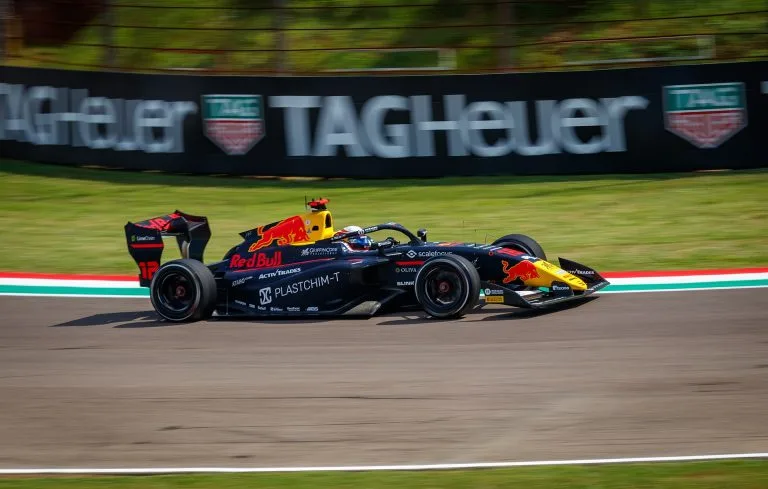
Valencia, Spain · 2025 Teams' champion, leading the 2026 title on 277 points · pictured in Red Bull junior colours at Imola
The third tier of the FIA's international single-seater pyramid, a single-make series on Dallara chassis positioned directly below Formula 2 and feeding into Formula 1.
Karting → Formula 4 → Formula Regional → FIA Formula 3 → FIA Formula 2 → Formula 1. F3 is the first rung that races full Grand Prix weekends.
No, but it is GP3's direct successor: GP3 (2010–2018) merged with the FIA F3 European Championship (2012–2018) to create the current FIA Formula 3 Championship in 2019.
The Sprint uses a grid reversed from the top 12 qualifiers and pays points to the top 10; the Feature uses the straight qualifying order and pays F1-style points to the top 10 plus bonus points for pole and fastest lap.
Robert Shwartzman (2019), Oscar Piastri (2020), Dennis Hauger (2021), Victor Martins (2022), Gabriel Bortoleto (2023), Leonardo Fornaroli (2024) and Rafael Câmara (2025).
After Monza on 6 September 2026, Freddie Slater (Trident) leads on 141 points from Ugo Ugochukwu (Campos Racing) on 126, with the Madrid finale on 11–13 September still to run. Campos leads the Teams' Championship on 277 points.
The Bahrain round scheduled for April was cancelled because of the Iran war. Rather than replace it, F3 added a second qualifying session and a second Feature Race to the Madrid finale, which now offers 67 points instead of the usual 39.
10 teams with three cars each, for 30 drivers on the 2026 grid.
A spec Dallara chassis with a Mecachrome 3.4-litre naturally aspirated V6 producing 380 hp. The current-generation car is the Dallara F3 2025, in use since the 2025 season.
The minimum age is 16, with a Grade A or B FIA racing licence required.
Exclusively as a support series to Formula 1 and Formula 2 Grand Prix weekends.
Oscar Piastri, Charles Leclerc, George Russell, Lando Norris, Lance Stroll, Mick Schumacher and Gabriel Bortoleto are among the F3/GP3 graduates who reached Formula 1.
F2 sits one rung higher — more powerful cars, closer in specification and performance to F1, and typically the final step before a driver reaches Formula 1.
No. Unless a product page explicitly states otherwise, Kozmozracing is an independent store and is not affiliated with or endorsed by the FIA, Formula 3, any team or driver.
Independent fan guide: Formats, teams and calendars can change. Verify current sporting information with the FIA and FIAFormula3.com directly. Championship, team and driver names belong to their respective rights holders.
No products are assigned to Formula 3 yet. Add products to this series in the product editor.