All-electric powertrains
Zero-emission single-seaters at every point in the championship's history — no combustion engine has ever raced.

Zero-emission racing on the world's most iconic city streets — the electric cars, teams and drivers behind the ABB FIA Formula E World Championship, now entering the GEN4 era.
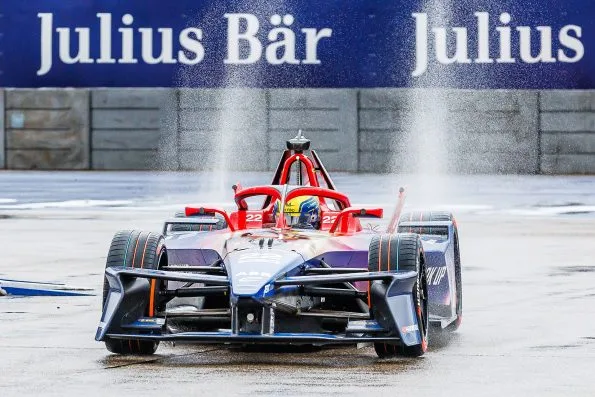
Formula E — officially the ABB FIA Formula E World Championship — is the world's top-tier all-electric single-seater racing series, governed by the FIA. Races, called ePrix, run mostly on temporary street circuits in major world cities. Since the 2020-21 season it has carried full FIA World Championship status, awarding Drivers' and Teams' titles, with a Manufacturers' Championship added from Season 10.
Formula E was conceived by Alejandro Agag together with then-FIA President Jean Todt around 2011–2012, launching its first-ever ePrix in Beijing on 13 September 2014.
Lucas di Grassi won that historic opening race, and Nelson Piquet Jr became the sport’s first-ever champion at the end of the inaugural 2014–15 season.
In December 2019 the FIA World Motor Sport Council granted Formula E full World Championship status effective the 2020–21 season, placing it alongside Formula 1, WEC, WRC and World Rallycross. A Manufacturers’ Championship followed in Season 10.
Formula E races zero-emission single-seaters on closed street circuits in major cities worldwide.
Zero-emission single-seaters at every point in the championship's history — no combustion engine has ever raced.
Races run on closed public roads in global cities rather than purpose-built tracks.
A temporary power boost from an off-line activation zone, plus a mandatory 600kW fast-charge pit stop, add a tactical layer no other series has.
Four car generations in twelve years, with the 815 hp GEN4 arriving for Season 13, and net-zero carbon certification since the very first season.
Practice, qualifying and the race typically run on the same day, except double-header rounds, which repeat the full format on both days.
The 20-car grid splits into two groups; the top four from each advance to knockout Duels that set the front rows.
Attack Mode, and on Pit Boost rounds a mandatory fast-charge stop, can decide the result.
Pit Boost is a mandatory ~30-second, 600kW fast charge adding roughly 10% battery energy; the battery must be between 40–60% to pit. From Season 13, double-header weekends pair the 45-minute E-Prix with a 30-minute, high-downforce "E-Prix Unleashed" sprint that has no Pit Boost at all.
| Pos | Points | Pos | Points |
|---|---|---|---|
| 1st | 25 | 6th | 8 |
| 2nd | 18 | 7th | 6 |
| 3rd | 15 | 8th | 4 |
| 4th | 12 | 9th | 2 |
| 5th | 10 | 10th | 1 |
Attack Mode and Pit Boost change a car's on-track performance but award nothing directly — they influence where a driver finishes, which is what scores.
| Rounds | ePrix | Circuit | Date |
|---|---|---|---|
| 01–02 | Jeddah | Jeddah Corniche Circuit, Saudi Arabia | 18–19 December 2026 |
| 03 | Mexico City | Autódromo Hermanos Rodríguez | 16 January 2027 |
| 04 | Austin | Circuit of the Americas, USA | 6 February 2027 |
| 05 | Miami | Miami International Autodrome, USA | 20 February 2027 |
| 06 | São Paulo | Anhembi Sambadrome, Brazil | 13 March 2027 |
| 07 | Sanya | Haitang Bay Circuit, China | 17 April 2027 |
| 08–09 | Monaco | Circuit de Monaco | 1–2 May 2027 |
| 10–11 | Berlin | Tempelhof Airport Street Circuit, Germany | 8–9 May 2027 |
| 12–13 | London | Brands Hatch, Great Britain | 29–30 May 2027 |
| 14–15 | Zandvoort | MASCOT Zandvoort Circuit, Netherlands | 18–19 June 2027 |
| 16–17 | Madrid | Circuito de Madrid Jarama-RACE, Spain | 26–27 June 2027 |
| 18–19 | Shanghai | Shanghai International Circuit, China | 10–11 July 2027 |
| 20–21 | Tokyo | Tokyo Street Circuit, Japan | 24–25 July 2027 |
Last updated: 7 September 2026. Season 12 finished at ExCeL London on 16 August 2026 with Pascal Wehrlein taking his second Drivers' title. Season 13 is the first GEN4 season and, at 21 races across 13 cities, the longest in Formula E history; Austin, Brands Hatch and Zandvoort are new venues. Provisional — verify with the official Formula E calendar.
Alejandro Agag develops an all-electric racing series with FIA President Jean Todt.
Formula E's debut race is held in Beijing; Lucas di Grassi wins and Nelson Piquet Jr becomes the first champion.
A new car eliminates mid-race car swaps and introduces Attack Mode.
All four major German manufacturers race in Formula E simultaneously.
The FIA grants Formula E full World Championship status from Season 7.
The fastest, lightest and most efficient Formula E car yet arrives for Season 9.
A front-axle motor adds four-wheel drive for qualifying, race starts and Attack Mode.
Pascal Wehrlein becomes the second driver to win two Formula E titles, at the London finale.
Around 200kW power; because batteries could not last a full race, drivers swapped to a second car mid-race.
Doubled energy storage eliminates mid-race car swaps entirely and introduces Attack Mode.
350kW power and 600kW regenerative capability — called the fastest, most efficient Formula car built to that date.
A front-axle motor adds four-wheel drive, active in qualifying, race starts and Attack Mode.
600kW, equivalent to over 815 hp, with active all-wheel drive and 0–60 mph in 1.8 seconds.
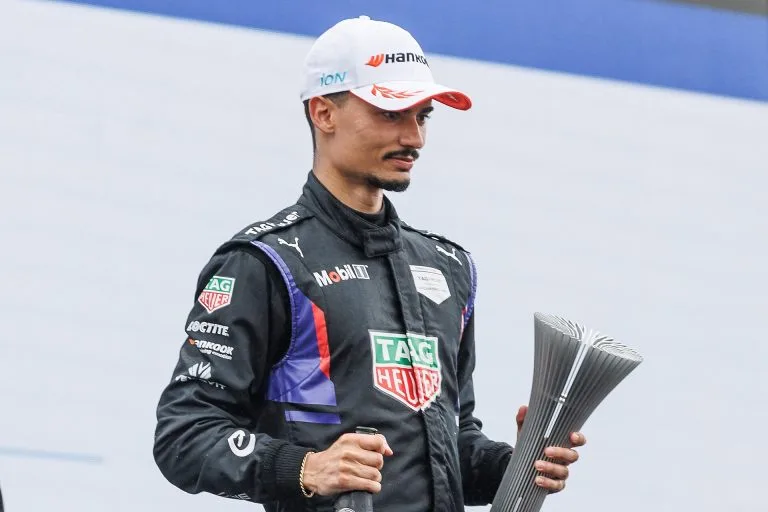
Season 12 (2025–26) Champion · Porsche Formula E Team · 169 points to Jake Dennis's 164 · his second title, after Season 10
The sport's first-ever champion, winning Season 1 (2014–15) in an 11-race inaugural season.
Season 2 (2015–16) champion with Renault e.Dams, and one of the series' longest-serving drivers.
Winner of the very first ePrix in Beijing, and Season 3 (2016–17) champion with Audi Sport ABT.
Champion in Seasons 4 and 5 with Techeetah — still the only driver to win back-to-back Formula E titles.
Season 6 (2019–20) champion with BMW i Andretti, still competing for Jaguar TCS Racing.
Won the very first FIA World Championship season, Season 7 (2020–21), with Mercedes-EQ.
Season 9 (2022–23) champion with Avalanche Andretti, and Wehrlein's title rival to the last lap of Season 12.
Season 11 (2024–25) champion with Nissan, breaking up Wehrlein's two title years.
Launches the championship; Lucas di Grassi wins the historic opener after the leaders collide on the last lap.
The FIA formally elevates Formula E alongside F1, WEC, WRC and World Rallycross.
Formula E completes its pandemic-affected Season 6 at a single Berlin venue.
Two founding manufacturers leave the series within the same year.
Wehrlein and Jake Dennis collide at ExCeL; Wehrlein takes the title by five points without scoring, while Jaguar beat Porsche to the Teams' crown by 17.
Formula E's most powerful car yet arrives alongside 21 races, a new E-Prix Unleashed sprint format, and moves to Brands Hatch, Austin and Zandvoort.
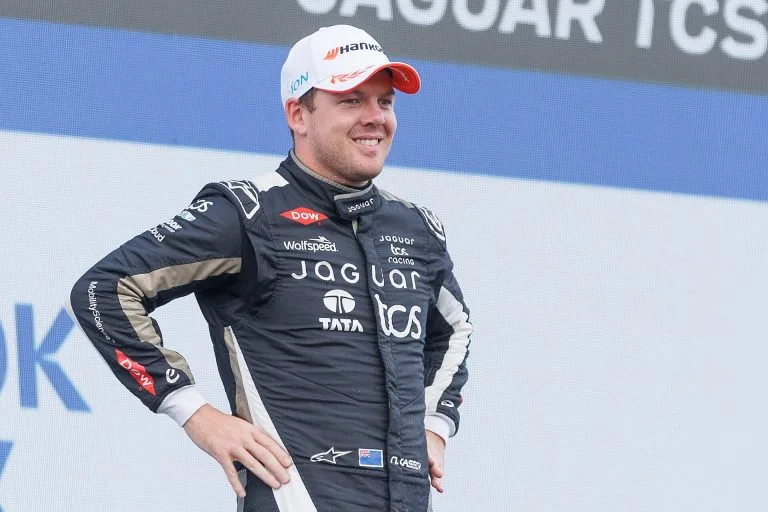
United Kingdom · 288 points to Porsche's 271 · Porsche took the Drivers' and Manufacturers' crowns
The FIA World Championship for all-electric single-seater race cars, raced mostly on city street circuits and officially called the ABB FIA Formula E World Championship.
Season 1 began on 13 September 2014 in Beijing, where Lucas di Grassi won the first-ever ePrix.
Yes, since the 2020–21 season, granted by the FIA World Motor Sport Council in December 2019.
Pascal Wehrlein (Porsche) took the Drivers' title on 169 points, ahead of Jake Dennis (Andretti) on 164 and Mitch Evans (Jaguar) on 160. Jaguar TCS Racing won the Teams' Championship with 288 points to Porsche's 271, while Porsche took the Manufacturers' title on 498 to Jaguar's 400.
Jean-Éric Vergne and Pascal Wehrlein have two each. Vergne's came back-to-back in Seasons 4 and 5; Wehrlein's were Seasons 10 and 12, with Oliver Rowland champion in between, so Vergne remains the only back-to-back winner.
10 teams and 20 drivers contested Season 12 (2025–26), two cars per team.
Formula E's fourth-generation car, racing from Season 13 (2026–27). It produces up to 600kW — over 815 hp — with active all-wheel drive and 0–60 mph in 1.8 seconds, making it the most powerful car in the championship's history.
The Gen3 Evo, introduced for Season 11 (2024–25), which added four-wheel drive via a front-axle motor and raced through Season 12.
A temporary power and all-wheel-drive boost drivers activate by driving through an off-racing-line activation zone, costing them time on track in exchange for extra power.
A mandatory mid-race pit stop where the car takes a 30-second, 600kW fast charge adding roughly 10% battery energy. It is used at selected rounds, and the battery must be between 40–60% to pit.
A new race type introduced for Season 13. On double-header weekends the classic 45-minute E-Prix is paired with a 30-minute, high-downforce sprint that has no Pit Boost, run to show the GEN4 car unrestricted.
A record 21 races across 13 cities, from Jeddah on 18–19 December 2026 to Tokyo on 24–25 July 2027. Austin's Circuit of the Americas, Brands Hatch and Zandvoort are new, and the London round moves from ExCeL to Brands Hatch.
It is core to the series' identity: bringing motorsport into city centres near fans rather than building dedicated circuits. Season 13 mixes in more permanent tracks to suit the faster GEN4 car.
Formula E states it was the first sport certified net-zero carbon from its very first season, and every car has been all-electric throughout the championship's history.
Audi, BMW, Mercedes, Porsche, Jaguar, Nissan, Mahindra, DS, Citroën, Maserati and Lola/Yamaha have all fielded manufacturer or manufacturer-powered teams at various points.
No. Unless a product page explicitly states otherwise, Kozmozracing is an independent store and is not affiliated with or endorsed by the FIA, Formula E, any team or driver.
Independent fan guide: Formats, teams and calendars can change. Verify current sporting information with the FIA and FIAFormulaE.com directly. Championship, team and driver names belong to their respective rights holders.
No products are assigned to Formula E yet. Add products to this series in the product editor.