A category, not a championship
Formula Regional certifies regional series to a shared standard. A driver can contest the European season, then the Middle East championship in the same year, in cars of the same class.

Not one championship but a whole FIA tier — six certified Formula Regional series racing on four continents, built to close the gap between Formula 4 and FIA Formula 3, and the category that produced Kimi Antonelli, Gabriel Bortoleto and Isack Hadjar.
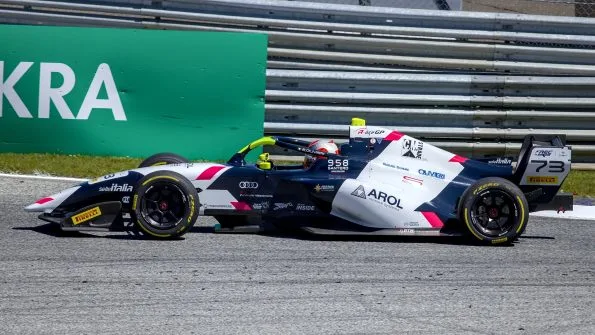
Formula Regional is an FIA category, not a single championship. Approved by the FIA World Motor Sport Council in December 2017 as "Regional Formula 3", it certifies regional one-make Formula Three championships to a shared standard, and sits between Formula 4 and the FIA Formula 3 Championship on the FIA Global Pathway to Formula 1. Formula Regional cars produce around 270 hp against roughly 160 for Formula 4 and 380 for FIA Formula 3. Six certified championships currently race: the Americas, Europe, Japan, Oceania, the Middle East and the World Cup at Macau. The European championship is the flagship.
The FIA World Motor Sport Council approved the concept in December 2017 under the name Regional Formula 3, written into Article 275 and Appendix J of the International Sporting Code. The problem it was created to solve was a gap: Formula 4 cars made around 160 hp, FIA Formula 3 around 380, and there was nothing in between.
The first two championships launched in 2018, in Asia and North America, followed by Europe in 2019 and Japan in 2020. Because several early championships still carried “F3” in their titles, the FIA gradually rebranded them all under the commercial name Formula Regional to avoid confusion with pre-2018 Formula 3 and with the international FIA Formula 3 Championship. The category was formally renamed Formula Regional in the 2024 technical regulations.
Several existing series were absorbed rather than replaced. The Formula Renault Eurocup adopted Formula Regional rules in 2019, New Zealand’s Toyota Racing Series — running since 2005 — adopted them in 2020 and became FIA-certified in 2023, and the all-female W Series ran to Formula Regional regulations for all three of its seasons.
One set of FIA regulations, six championships, and a very precise job on the ladder.
Formula Regional certifies regional series to a shared standard. A driver can contest the European season, then the Middle East championship in the same year, in cars of the same class.
At Spa in 2024 the fastest Formula Regional race lap was 2:16.505. FIA Formula 3 managed 2:05.770 at the same circuit that year, and French Formula 4 2:22.539. That is the whole design brief in three numbers.
Drivers who have raced both describe Formula Regional cars as close to FIA Formula 3 in weight but with much less downforce and less power — which is why it teaches car control before aerodynamic grip.
Chassis and engines differ by region: Ligier and Honda in the Americas, Tatuus and Toyota in Europe and Oceania, Dome and Alfa Romeo in Japan. The performance window is what the FIA standardises.
Two sessions across the weekend set the grids for the main races. At three-race rounds the top twelve of the first session are reversed for the sprint.
Full points, 25 for a win, plus bonus points for pole position and fastest lap — both new for 2026.
A third, shorter race on a reversed grid paying reduced points, added in 2026 when the calendar shrank from ten events to eight.
The European car carries push-to-pass: a 15-second boost usable five times per race. Formats differ between the six championships — this is the European one.
| Pos | Main race | Sprint |
|---|---|---|
| 1st | 25 | 10 |
| 2nd | 18 | 9 |
| 3rd | 15 | 8 |
| 4th | 12 | 7 |
| 5th | 10 | 6 |
| 6th | 8 | 5 |
| 7th | 6 | 4 |
| 8th | 4 | 3 |
| 9th | 2 | 2 |
| 10th | 1 | 1 |
Scoring varies between the six Formula Regional championships. This is the 2026 European system, which was overhauled when the calendar was cut from ten events to eight.
| Round | Races | Circuit | Date |
|---|---|---|---|
| 01 | 3 races | Red Bull Ring, Spielberg, Austria | 25–26 April |
| 02 | 2 races | Circuit Zandvoort, Netherlands | 23–24 May |
| 03 | 3 races | Circuit de Spa-Francorchamps, Belgium | 30–31 May |
| 04 | 3 races | Monza Circuit, Italy | 20–21 June |
| 05 | 2 races | Hungaroring, Hungary | 4–5 July |
| 06 | 2 races | Circuit Paul Ricard, Le Castellet, France | 18–19 July |
| 07 | 3 races | Imola Circuit, Italy | 5–6 September |
| 08 | 2 races | Hockenheimring, Germany | 12–13 September |
Last updated: 7 September 2026. Eight events and twenty races, down from ten events — Misano and Barcelona did not return, and four rounds gained a third race instead. Seven rounds are complete: Emanuele Olivieri leads on 200 points from Sebastian Wheldon on 180 and Kean Nakamura-Berta on 175, with the Hockenheim finale still to run. The other five Formula Regional championships run their own calendars.
The FIA World Motor Sport Council signs off Regional Formula 3 in December, to bridge Formula 4 and FIA Formula 3.
Asia and North America launch, on the Tatuus T-318 and the Ligier JS F3.
The European championship debuts, the Formula Renault Eurocup adopts the regulations, and the new all-female W Series races to them too.
Japan launches on the Dome F111/3, and New Zealand's Toyota Racing Series — running since 2005 — adopts Formula Regional rules.
The European championship becomes Formula Regional European Championship by Alpine, with Renault Sport engines.
A Middle East championship launches, and the Oceania series becomes a fully FIA-certified Formula Regional championship.
Macau begins hosting the FIA Formula Regional World Cup, and the category is formally renamed Formula Regional in the technical regulations.
Europe splits from Alpine after five seasons, retires the Tatuus FR-19 after seven, and switches to the Tatuus T-326 with Toyota power. Australia's AU3 Championship joins the category.
The original Formula Regional car, still racing in the Middle East and at the Macau World Cup, and the chassis W Series used.
The Americas championship's car, uniquely powered by a Honda 2.0-litre, and the only non-Tatuus, non-Dome chassis in the category.
Europe's car for seven seasons, on Renault Sport power from 2021. Also used by the Formula Renault Eurocup and the Ultimate Cup Series.
Built for New Zealand's Toyota Racing Series, now the Oceania championship's car and the basis of Australia's AU3 Championship from 2026.
The Japanese championship's chassis, and the only Formula Regional car built in Japan.
Europe's new car, replacing the FR-19 and paired with a Toyota G16E-GTS 1.6-litre.

2025 Formula Regional European Champion · Prema Racing · Prema's fourth title in a row, and he led the FIA Formula 3 championship the following season
2023 European champion with Prema at sixteen, in Formula 1 with Mercedes from 2025.
2024 European champion with Prema, who then won the 2025 FIA Formula 3 title in his rookie season.
2022 European champion with Prema and a Ferrari junior, later racing in Formula 2.
2021 European champion with ART Grand Prix — the only driver to break Prema's grip on the title.
The category's first European champion, in 2019 with Prema, later a Mercedes junior and Formula 2 race winner.
Raced the European championship before winning the FIA Formula 3 and Formula 2 titles back to back, and reaching Formula 1 with Sauber.
The first European-championship graduate to reach Formula 1, called up by Williams mid-2024.
Second in the 2026 European championship in his first season with MP Motorsport, and the son of IndyCar champion and two-time Indianapolis 500 winner Dan Wheldon.
Before Formula Regional, drivers jumped from 160 hp Formula 4 cars straight to 380 hp FIA Formula 3 machinery. The category exists because that step was too big.
One of Europe's great feeder series adopts Formula Regional rules in 2019 and is gone a season later, absorbed into the new order.
Two of the category's early adopters fall away in the same year — W Series to financial collapse, the Asian championship after five seasons.
After years of championships carrying confusing "F3" titles, Formula Regional is written into the technical regulations as the category's formal name.
Franco Colapinto becomes the first European-championship graduate to race in Formula 1, joining Williams mid-season.
The flagship championship loses its title partner and engine supplier after five seasons, and changes both car and engine in one winter.
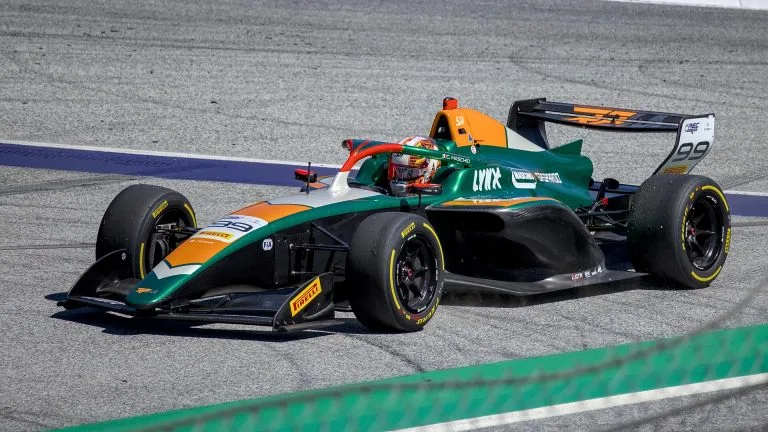
Eighth season in 2026 · new Tatuus T-326 and Toyota power after splitting from Alpine · R-ace GP lead the teams' standings on 401 points from MP Motorsport and Prema
An FIA category rather than a single championship. It certifies regional one-make Formula Three series to a shared performance standard, and sits between Formula 4 and the FIA Formula 3 Championship on the ladder to Formula 1.
Six certified championships currently race: the Americas, Europe, Japan, Oceania, the Middle East and the World Cup at Macau. Australia's AU3 Championship joined the category in 2026.
The FIA Formula Regional European Championship. It has the strongest grids and the best record of putting drivers into Formula 1.
Around 270 hp, against roughly 160 for Formula 4 and 380 for FIA Formula 3. At Spa in 2024 the fastest Formula Regional race lap was 2:16.505, compared with 2:05.770 for FIA Formula 3 and 2:22.539 for French Formula 4 at the same circuit.
No. It was created as "Regional Formula 3" and renamed to avoid exactly that confusion. FIA Formula 3 is the single global championship that races on Formula 1 weekends; Formula Regional is the tier below it.
Six chassis across the category: the Tatuus T-318, FR-19, T-326 and FT-60, the Ligier JS F3 in the Americas, and the Dome F111/3 in Japan. Engines come from Honda, Alfa Romeo, Renault Sport or Toyota depending on the championship.
A great deal. The championship split from Alpine after five seasons and is now the FIA Formula Regional European Championship; the Tatuus FR-19 was retired after seven years for the new Tatuus T-326; the engine changed from Renault Sport to Toyota; the calendar shrank from ten events to eight with four rounds gaining a third race; and pole and fastest-lap points were introduced.
After seven of eight rounds, Emanuele Olivieri leads on 200 points from Sebastian Wheldon on 180 and Kean Nakamura-Berta on 175. R-ace GP lead the teams' standings on 401. The finale is at Hockenheim on 12–13 September.
Frederik Vesti (2019), Gianluca Petecof (2020), Grégoire Saucy (2021), Dino Beganovic (2022), Kimi Antonelli (2023), Rafael Câmara (2024) and Freddie Slater (2025). Prema Racing has won six of the seven.
Franco Colapinto was the first to reach Formula 1, with Williams in 2024. Kimi Antonelli went to Mercedes, Gabriel Bortoleto to Sauber and Isack Hadjar to Racing Bulls, all for 2025.
It raced to Formula Regional regulations for all three of its seasons on the Tatuus T-318, but it was not an FIA-certified Formula Regional championship. It folded in 2022.
In the European championship, a 15-second power boost that a driver may use five times per race.
Yes. France's Ultimate Cup Series has run to the regulations since 2020 and Eurocup-3 since 2023, without being FIA-certified Formula Regional championships. A Formula Regional Indian Championship has been announced but not confirmed.
No. Unless a product page explicitly states otherwise, Kozmozracing is an independent store and is not affiliated with or endorsed by the FIA, any Formula Regional championship, team or driver.
Independent fan guide: Formats, calendars and regulations differ between the six Formula Regional championships and can change. Verify current sporting information with the FIA and the relevant championship directly. Championship, team and driver names belong to their respective rights holders.
No products are assigned to Formula Regional yet. Add products to this series in the product editor.