The oldest endurance race in the world

Le Mans 24H

Twenty-four hours on thirteen kilometres of French public road, every June since 1923. It rewards the car still running at four o'clock on Sunday, not the one that was quickest on Saturday.

1923First race, the oldest still running
24Hours, from 4pm on Saturday
62Cars on the grid
WinnersThe circuitClassesTraditionsRecords
Le Mans 24h

What is the 24 Hours of Le Mans?

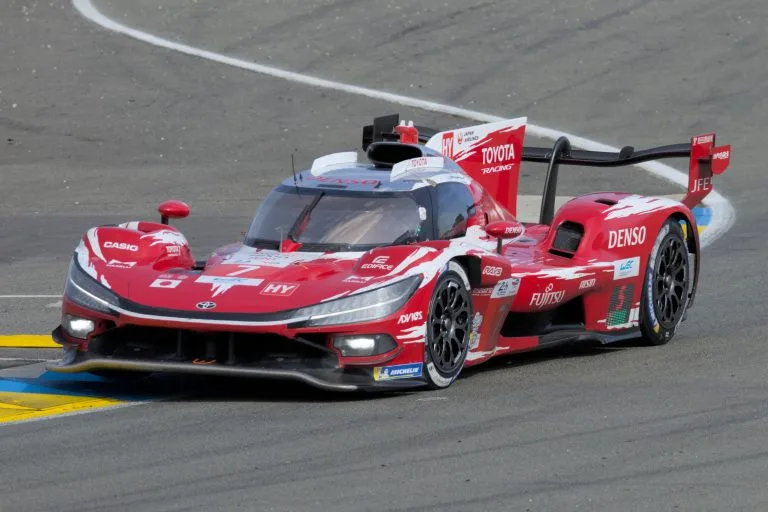
The 24 Hours of Le Mans is an endurance sports car race held each year near the city of Le Mans in France. First run in 1923, it is the oldest active endurance race in the world and one of the most prestigious races anywhere. Cars run for a full twenty-four hours from four o'clock on Saturday afternoon around the 13.626-kilometre Circuit de la Sarthe, part permanent circuit and part public road closed for the weekend. Sixty-two cars start in three classes — Hypercar, LMP2 and LMGT3 — with a prize for each class winner as well as the overall victory, and it has been a round of the FIA World Endurance Championship since 2012. The 2026 event was the 94th running: Toyota Racing's No. 7 won it on 13–14 June with 381 laps.

First run
1923, near Le Mans in France
Circuit
Circuit de la Sarthe, 13.626 km
2026 winners
Mike Conway, Kamui Kobayashi, Nyck de Vries — Toyota
Records
Tom Kristensen 9 wins · Porsche 19 · Joest Racing 15
01 — How it began

A race built to reward reliability.

Le Mans was launched in 1923, when Grand Prix racing was the dominant form of motorsport across Europe, and it was designed to present a different test. Instead of asking which company could build the fastest car, it asked which could build a sporty car that lasted. Endurance racing needs machinery that survives and spends as little time in the pits as possible, so the race rewarded reliability and efficiency from the beginning.

The circuit shaped the cars too. Few tracks in Europe had a straight to compare with the Ligne droite des Hunaudières — the Mulsanne, named after the village it runs towards — so Le Mans demanded aerodynamics and stability at speeds nowhere else required.

The oil crisis of the early 1970s pushed the idea further. Organisers adopted a fuel-economy formula, Group C, that limited how much fuel each car could use. The formula was eventually abandoned but the principle stuck: less time refuelling is time gained, and hybrid systems arrived in the 2000s for the same reason. Much of it has trickled down into road cars, and into the supercars manufacturers build to turn into GT racers.

The race has been run under many rule sets and championships. Since 2012 it has been a round of the FIA World Endurance Championship, and in 2026 it was the third of eight.

Lap
13.626 km of permanent circuit and closed public road
Race
24 hours, from 16:00 local time on Saturday
Grid
62 cars, since 2019
Classes
Hypercar, LMP2 and LMGT3
Hypercar
LMH or LMDh rules, the top class since 2021
LMP2
ORECA, Ligier, Dallara or Multimatic/Riley chassis with a 4.2-litre Gibson V8
Cockpits
Closed for all prototypes since 2017
Top speed now
Just under 320 km/h; the post-chicane record is 366 km/h
Before the chicanes
407 km/h, Roger Dorchy in a WM P88, 1988
02 — The essentials

What makes Le Mans different.

A day and a night, three classes racing at once, and a rulebook written around lasting rather than winning.

01

Engine off to refuel

A rule unique to Le Mans: cars must be switched off while fuel goes in. It is safer, and it is another test of reliability — the car has to restart, many times, under race conditions. Mechanics may not work on it while it is refuelling, beyond helping a driver in or out. The same rules now apply across the World Endurance Championship.

02

An hour before you top up

For many decades a car had to run at least an hour before it could replace any fluid other than fuel — oil or coolant included. Anything that could not last that hour without a top-up risked disqualification. It was the ACO's way of forcing efficiency and reliability.

03

Three classes, four prizes

Hypercar, LMP2 and LMGT3 all race at the same time, with a prize for each class winner as well as the overall victory. In 2026 LMP2 also had a Pro-Am sub-class, so four cars took a trophy.

04

The Mulsanne, cut into three

In 1990 the FIA decided it would no longer sanction a circuit with a straight longer than two kilometres. Two chicanes were added to the six-kilometre Mulsanne, dividing it into three roughly equal pieces — a decision helped along by Roger Dorchy being timed at 407 km/h there in 1988.

03 — The race week

A Le Mans week, decoded.

The build-up

Inspection, then evenings

Cars are inspected on Monday and Tuesday. Practice and qualifying follow on Wednesday and Thursday, held in the evening as two separate two-hour sessions each night. Friday is a rest day, with a parade of all the drivers through the town.

The start

Four o'clock, and a tricolour

The race has started at 16:00 local time on Saturday since its inception, and again since 2021. The French tricolour is waved to start it, usually after a fly-past trailing blue, white and red smoke.

The finish

The marshals wave you home

On the final lap, track marshals wave safety flags to congratulate the winners — and every other car still running.

Pre-qualification, which used to weed out the slowest cars at a spring test, was abolished in 2000; since 2005 the test day has been held on the first weekend of June.

04 — How it is decided

How the winner is decided.

RuleHow it works
Greatest distance Measured at the start/finish line, as of the final lap's completion
Equal laps The faster overall completion time wins
To be classified A car must complete the final lap, inside a prescribed maximum lap time
Waiting for the flag Prohibited by rule, after damaged cars crawled across the line to be classified

Eight metres, 1966

Distance was once measured from a car’s starting position, which caught Ford out. Leading 1–2, its two cars slowed for a photograph at the line with Ken Miles just ahead of Bruce McLaren — but McLaren had started much further back and so had covered more ground. The margin was eight metres. McLaren and Chris Amon were declared the winners; Miles, who had already won Sebring and Daytona that year, would have been the first man to take all three, and in the same season.

The rule changed with the rolling start in 1971. It was needed again in 2011, when the top two cars both completed 355 laps and were separated by thirteen seconds.

05 — The 2026 race

The 94th running.

The 2026 race was the third round of eight in the FIA World Endurance Championship. Le Mans normally falls on the second weekend of June.
Class Winning team Drivers
Hypercar Toyota Racing Mike Conway, Kamui Kobayashi, Nyck de Vries
LMP2 Inter Europol Competition Tom Dillmann, Jakub Śmiechowski, Nick Yelloly
LMP2 Pro-Am CrowdStrike Racing by APR Laurin Heinrich, George Kurtz, Alex Quinn
LMGT3 TF Sport Nicky Catsburg, Jonny Edgar, Ben Keating

381 laps and 5,191.506 km in dry weather, on 13–14 June 2026. Dries Vanthoor took pole for BMW M Team WRT with a 3:22.564, and BMW finished second overall with Robin Frijns, René Rast and Sheldon van der Linde. Genesis Magma Racing became the first South Korean manufacturer team to finish the race, thirteenth overall.

06 — From 1923 to today

Race timeline.

1923

The first race

Run on 26–27 May over public roads near Le Mans, conceived as a test of reliability and efficiency rather than outright speed.

1936–1948

Ten cancellations

The race was lost to a labour strike during the Great Depression in 1936, then to the Second World War from 1940 to 1948.

1966

Eight metres

Ford led 1–2 and slowed for a photograph at the line, only for Bruce McLaren to be declared the winner over Ken Miles, because he had started further back and so covered more distance.

1967

The champagne

Dan Gurney won with A. J. Foyt and, handed a magnum on the podium, shook it and sprayed everyone below — the first televised instance of a winner spraying champagne instead of drinking it.

1971

The running start ends

The Le Mans start, in which drivers sprinted across the track to their cars, was replaced by a rolling start after harness-less drivers died in accidents in the bunched opening laps.

1990

The Mulsanne is cut

The FIA refused to sanction circuits with a straight longer than two kilometres, so two chicanes split the six-kilometre Mulsanne into three. Roger Dorchy had been timed there at 407 km/h two years earlier.

2012

A world championship round

Le Mans became a round of the new FIA World Endurance Championship, and the Garage 56 programme began admitting experimental cars outside the classes.

2021

Hypercar

LMP1 gave way to Hypercar, built to LMH or LMDh rules, intended to hold costs down while allowing more variety in engineering and shape.

2026

Toyota again

The 94th running went to Toyota's No. 7 — a sixth overall win, its first since 2022, and the end of three consecutive victories for the Ferrari 499P.

07 — The classes

Who races, and in what.

Hypercar

The top class since 2021

Built to LMH or LMDh rules as the successor to LMP1, written to prevent cost escalation while allowing greater variety in technical approach and in how the cars look.

LMP2

A controlled prototype

Teams must use one of four approved chassis — ORECA, Ligier, Dallara or Multimatic/Riley — with a standard 4.2-litre Gibson V8. ORECA is the one most teams choose.

LMGT3

Closest to the showroom

Production-based sports cars, and the class that puts the most manufacturers on the grid.

Garage 56

The experiment

Since 2012 a place has been kept for a concept car demonstrating new technology. It is classified in the results but is not expected to be competitive; that is not what it is there for.

08 — Winners and record holders

Racers who defined it.

Toyota Racing — No. 7
2026 Winners

Toyota Racing — No. 7

Mike Conway, Kamui Kobayashi and Nyck de Vries completed 381 laps in 24 hours 3 minutes 1.030 seconds to win the 94th running on 13–14 June 2026. It was Toyota's sixth overall victory and its first since 2022, ending three consecutive wins for the Ferrari 499P. A second Le Mans for Conway and Kobayashi, who also won in 2021, and a first for de Vries.

9 WINS

Tom Kristensen

The record, taken between 1997 and 2013 — seven of them with Audi, and six in a row.

9 wins
6 WINS

Jacky Ickx

Won six times between 1969 and 1982 and was made an honorary citizen of the town. Derek Bell, often his co-driver, has five.

6 wins
33 STARTS

Henri Pescarolo

Four victories, and the record for the most appearances at the race.

33 starts
TRIPLE CROWN

Graham Hill

The only driver to have won the Indianapolis 500, the Monaco Grand Prix and Le Mans. The last of the three came in 1972.

Le Mans 1972
PERFECT RECORD

Fernando Alonso

Won both the Le Mans races he entered, in 2018 and 2019. A. J. Foyt, Tazio Nuvolari, Luis Fontés, Woolf Barnato and Nico Hülkenberg also won every Le Mans they started.

2 from 2
2026 WINNER

Kamui Kobayashi

A second Le Mans victory, five years after the first, sharing the No. 7 Toyota with Mike Conway and Nyck de Vries.

2 wins
THE CHAMPAGNE

Dan Gurney

Won in 1967 with A. J. Foyt and invented the podium champagne spray on the spot, aiming it at the Ford executives who had predicted disaster.

Le Mans 1967
7 CLASS WINS

Claude Ballot-Léna

The most class victories of anyone other than Kristensen, taken in GT cars between 1970 and 1986.

7 class wins
09 — Defining events

Turning points.

01

A different test from Grand Prix racing

Le Mans was launched into a Europe where Grand Prix racing was the point of motorsport, and it deliberately asked a different question: not who is fastest, but whose car lasts. The oil crisis turned that into fuel economy with Group C; hybrids arrived in the 2000s for the same reason. Much of it reached road cars.

02

The start that killed drivers

For decades the drivers stood across the track from their cars and ran to them when the flag dropped. Safety harnesses were then a recent invention, and drivers either skipped them or tried to fasten them while driving, which killed several in the bunched opening laps. It also produced two pieces of engineering folklore: Porsche moved the ignition key to the left of the wheel so a driver could start the engine and select a gear at the same time, and Stirling Moss sat waiting in gear and jerked his car forward on the starter motor before dipping the clutch to fire it. A rolling start replaced it in 1971.

03

Six kilometres, then three

Roger Dorchy's WM P88 was timed at 407 km/h on the Mulsanne in 1988. Two years later the FIA declared it would sanction no circuit with a straight over two kilometres, and two chicanes split the straight into three. The record since is 366 km/h, and cars now top out just under 320.

10 — All-time

The most successful marques.

Porsche
Most successful marque

Porsche

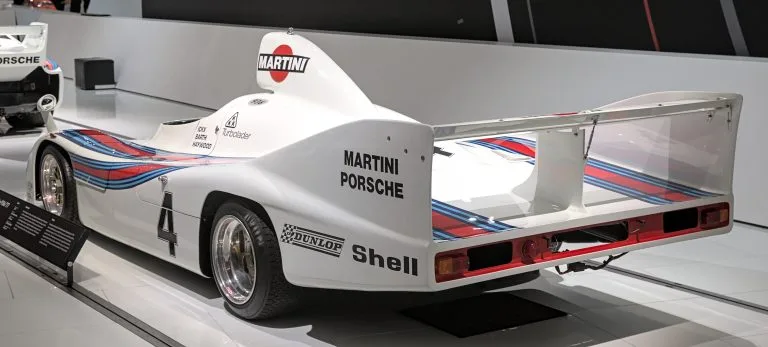
Nineteen overall victories, including seven consecutive wins from 1981 to 1987, and 107 class wins — more than twice as many as anyone else. Audi follows on thirteen overall and Ferrari on eleven. Among teams rather than marques, Joest Racing holds the record with fifteen.

#1 19 PorscheSeven in a row from 1981 to 1987, and 107 class wins #2 13 AudiThirteen wins in fifteen years of entering after 2000
#3 11 FerrariSix in a row from 1960 to 1965, and 37 class wins
#4 6 ToyotaThe sixth came in 2026, ending three straight wins for the Ferrari 499P
11 — Frequently asked

Le Mans FAQ.

What is the 24 Hours of Le Mans?

An endurance sports car race held each year near Le Mans in France, first run in 1923 and the oldest active endurance race in the world. Cars run for a full twenty-four hours on the Circuit de la Sarthe.

When does it start?

At four o'clock on Saturday afternoon, local time. That has been the start time since the race began, and again since 2021. It usually falls on the second weekend of June.

How long is a lap?

13.626 km. The Circuit de la Sarthe is part permanent circuit and part public road, closed for the race weekend, and it has been modified extensively since 1923 — mostly for safety.

How many cars race?

Sixty-two, since 2019, in three classes: Hypercar, LMP2 and LMGT3. All of them race at the same time, and each class winner takes a prize as well as the overall winner.

Who won in 2026?

Toyota Racing's No. 7, driven by Mike Conway, Kamui Kobayashi and Nyck de Vries, with 381 laps in 24 hours 3 minutes and 1.030 seconds. It was Toyota's sixth win and its first since 2022.

Who has won Le Mans the most times?

Tom Kristensen, with nine victories between 1997 and 2013, seven of them with Audi and six of them consecutive. Jacky Ickx is next with six.

Which manufacturer has won the most?

Porsche, with nineteen overall wins including seven in a row from 1981 to 1987, and 107 class victories. Audi has thirteen and Ferrari eleven.

Why must cars switch off to refuel?

It is safer, and it is another test of reliability: the car has to restart under race conditions, many times over twenty-four hours. Mechanics also may not work on a car while it is being refuelled, beyond helping a driver in or out.

How is the winner decided?

By greatest distance covered, measured at the start/finish line as of the final lap's completion. If two cars finish on the same number of laps, the faster overall completion time wins. A car must also complete that final lap inside a prescribed maximum lap time to be classified.

What was the Le Mans start?

Until 1971 the cars were lined up along the pits and the drivers stood across the track. When the flag dropped they ran to their cars, started them unaided and drove away. It was abandoned after drivers who skipped their safety harnesses died in accidents at the start.

What is the Mulsanne Straight?

The long straight on the public-road section, properly the Ligne droite des Hunaudières. It ran six kilometres uninterrupted until 1990, when the FIA refused to sanction straights over two kilometres and two chicanes were added.

How fast do the cars go?

Just under 320 km/h at the current circuit. The record since the chicanes were added is 366 km/h; before them, Roger Dorchy was timed at 407 km/h in a WM P88 in 1988.

What is Garage 56?

A place kept since 2012 for a concept car demonstrating experimental technology. Such entries are classified in the results but are not expected to be competitive.

Is Le Mans part of a championship?

Yes — it has been a round of the FIA World Endurance Championship since 2012. In 2026 it was the third of eight rounds.

Why is champagne sprayed on podiums?

Because of Le Mans. Dan Gurney won the 1967 race with A. J. Foyt, was handed a magnum on the podium, and shook it over the executives and journalists below. It was the first televised instance of a winner spraying champagne rather than drinking it.

Sources

Independent fan guide: Le Mans revises its classes and technical rules regularly, and the circuit itself has changed many times. Verify current sporting information with the Automobile Club de l'Ouest directly. Race, team and driver names belong to their respective rights holders.

12 — The collection

Le Mans collection.

No products are assigned to Le Mans 24h yet. Add products to this series in the product editor.

0 View cart