Prototypes, not road bikes
Every MotoGP machine is built to the rulebook and cannot be bought. That is the line between MotoGP and World Superbike.

Prototype machinery you cannot buy, three classes on one bill, and two races every weekend since the Sprint arrived in 2023.
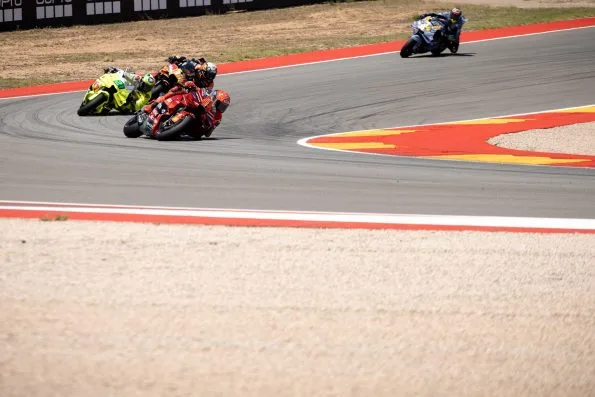
MotoGP is the premier class of Grand Prix motorcycle racing, the world championship sanctioned by the FIM and promoted by Dorna Sports. Running since 1949, it is the oldest motorsport world championship still going. Every bike on the grid is a prototype built to the rulebook rather than a modified road bike, and since 2023 each round has carried both a Saturday Sprint and a Sunday Grand Prix.
The FIM launched the Grand Prix motorcycle world championship in 1949, running several capacity classes on the same weekend. The 500cc class was the premier category from the start, and it stayed that way for more than half a century.
Two-stroke engines took over the premier class through the 1970s and defined it for a generation — lighter, more powerful and far harder to ride than the four-strokes they replaced. Valentino Rossi took the last 500cc two-stroke title in 2001.
In 2002 the class was renamed MotoGP and opened to 990cc four-stroke prototypes. Capacity has been used as a control ever since: cut to 800cc in 2007, restored to 1,000cc in 2012, and dropping to 850cc in 2027. Sprint races arrived in 2023, and Liberty Media bought promoter Dorna Sports in 2025.
A prototype championship with a built-in ladder and two scoring races every weekend.
Every MotoGP machine is built to the rulebook and cannot be bought. That is the line between MotoGP and World Superbike.
Moto3, Moto2 and MotoGP race at every round, so the paddock carries its own career ladder.
Since 2023 Saturday has its own shorter race with its own points, on top of Sunday's full-distance Grand Prix.
Winglets and rear ride-height systems have reshaped how the bikes launch, brake and turn over the last decade.
Free practice plus a timed session that decides who goes straight into Q2 and who has to fight through Q1.
Q1 and Q2 set the grid for both races, then the Sprint runs at roughly half Grand Prix distance.
Full distance, full points, and the same grid the Saturday qualifying produced.
The Sprint result does not change the Sunday grid — qualifying sets both.
| Pos | Grand Prix | Sprint |
|---|---|---|
| 1st | 25 | 12 |
| 2nd | 20 | 9 |
| 3rd | 16 | 7 |
| 4th | 13 | 6 |
| 5th | 11 | 5 |
| 6th | 10 | 4 |
| 7th | 9 | 3 |
| 8th | 8 | 2 |
| 9th | 7 | 1 |
| 10th | 6 | — |
| 11th | 5 | — |
| 12th | 4 | — |
| 13th | 3 | — |
| 14th | 2 | — |
| 15th | 1 | — |
Sprint races were introduced in 2023 and are run at every round, which is why season totals jumped sharply from that year.
| Round | Grand Prix | Circuit | Date |
|---|---|---|---|
| 01 | Thailand | Chang International Circuit, Buriram | 1 March |
| 02 | Brazil | Autódromo Ayrton Senna, Goiânia | 22 March |
| 03 | Americas | Circuit of the Americas, Austin | 29 March |
| 04 | Spain | Circuito de Jerez | 26 April |
| 05 | France | Bugatti Circuit, Le Mans | 10 May |
| 06 | Catalunya | Circuit de Barcelona-Catalunya | 17 May |
| 07 | Italy | Autodromo Internazionale del Mugello | 31 May |
| 08 | Hungary | Balaton Park Circuit | 7 June |
| 09 | Czechia | Brno Circuit | 21 June |
| 10 | Netherlands | TT Circuit Assen | 28 June |
| 11 | Germany | Sachsenring | 12 July |
| 12 | Great Britain | Silverstone Circuit | 9 August |
| 13 | Aragon | MotorLand Aragón | 30 August |
| 14 | San Marino | Misano World Circuit Marco Simoncelli | 13 September |
| 15 | Austria | Red Bull Ring, Spielberg | 20 September |
| 16 | Japan | Mobility Resort Motegi | 4 October |
| 17 | Indonesia | Pertamina Mandalika Circuit | 11 October |
| 18 | Australia | Phillip Island | 25 October |
| 19 | Malaysia | Sepang International Circuit | 1 November |
| 20 | Qatar | Lusail International Circuit | 8 November |
| 21 | Portugal | Algarve International Circuit, Portimão | 22 November |
| 22 | Valencia | Circuit Ricardo Tormo | 29 November |
Last updated: 6 September 2026, after thirteen of twenty-two rounds. Verify current dates with the official MotoGP calendar.
The FIM launches the Grand Prix world championship across several capacity classes.
The first of seven consecutive premier-class titles, a record that still stands.
The premier class shifts decisively to two-stroke power for the next quarter-century.
Valentino Rossi wins the final two-stroke premier championship.
The class is renamed and opened to 990cc four-stroke prototypes.
Capacity returns to a litre after five seasons at 800cc.
A shorter Saturday race with its own points is added at every round.
The championship's commercial rights change hands, and Marc Márquez takes a seventh premier title.
Multi-cylinder four-strokes from MV Agusta and Honda set the early standard, with Agostini dominant.
Lighter, more powerful and famously difficult, the 500cc two-strokes defined a generation of Grand Prix racing.
The MotoGP name arrives with bigger, heavier four-strokes and a wide-open technical brief.
Capacity is cut to rein in corner speed, and corner speed becomes the whole game.
1,000cc returns, and aerodynamics plus ride-height devices become the defining battleground.
2025 MotoGP World Champion · Ducati Lenovo Team · seventh premier-class title
Eight premier-class titles between 1966 and 1975, seven of them in a row — still the outright record.
Seven premier-class championships across four manufacturers, and the rider who took the sport mainstream.
Took a seventh premier title in 2025, six years after his sixth — the longest gap between titles in the class.
The American who brought dirt-track technique to Grand Prix and won three straight 500cc titles from 1978.
Three consecutive 500cc championships from 1990 before a crash at Misano ended his riding career.
Britain's twice 500cc world champion and the rider who made Grand Prix racing front-page news at home.
Back-to-back MotoGP titles in 2022 and 2023 with Ducati, the factory's first since Stoner in 2007.
The 2024 champion, now leading the 2026 standings for Aprilia after thirteen rounds.
Three-time champion Wayne Rainey is paralysed, and rider safety moves to the centre of the sport.
Renaming the class and changing its engines resets the competitive order overnight.
Marco Simoncelli is killed in a Grand Prix, prompting another hard look at protective equipment and run-off.
An arm injury in the opening round removes the dominant rider, and the title goes to a first-time champion.
Doubling the racing per weekend changes how riders manage tyres, risk and a championship.
The commercial owner of Formula 1 takes control of MotoGP's rights.
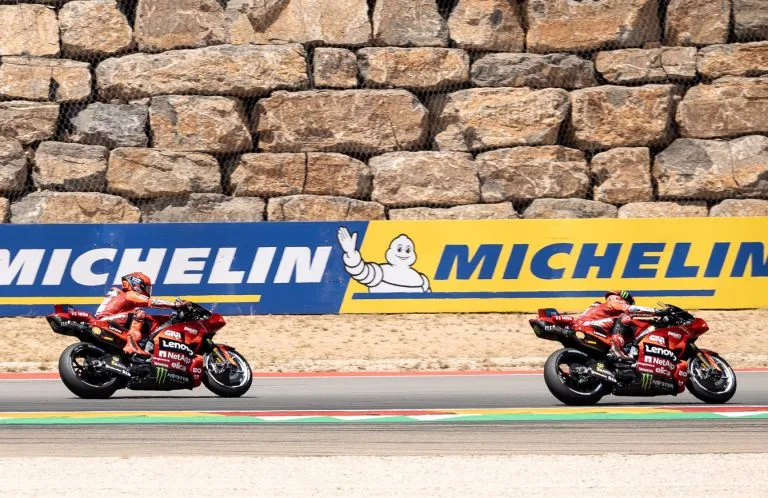
2025 MotoGP Teams' Champion · Ducati's sixth straight constructors' title
MotoGP is the premier class of Grand Prix motorcycle racing, the world championship sanctioned by the FIM and promoted by Dorna Sports. It has run since 1949, which makes it the oldest motorsport world championship still running.
The FIM sets the sporting and technical rules; Dorna Sports holds the commercial rights and has been owned by Liberty Media since 2025.
Moto3 (250cc single-cylinder four-stroke), Moto2 (a spec 765cc Triumph triple) and MotoGP (1,000cc prototypes). They form a ladder, and all three race at every round.
No. MotoGP machines are pure prototypes built to a rulebook, not homologated production bikes. That is the difference between MotoGP and World Superbike, which races modified road bikes.
A shorter Saturday race, roughly half Grand Prix distance, introduced in 2023. It pays its own points and does not set the Sunday grid.
The Grand Prix pays the top 15 on a 25-20-16-13-11-10-9-8-7-6-5-4-3-2-1 scale. The Sprint pays the top 9 on 12-9-7-6-5-4-3-2-1. Both count toward the same championship.
No. Qualifying sets the grid for both races; the Sprint is a separate result.
The premier class moved to four-strokes in 2002 when the MotoGP name and a 990cc limit arrived. Valentino Rossi was the last two-stroke 500cc champion, in 2001.
Capacity has been used to manage speed and cost: 990cc from 2002, cut to 800cc in 2007, back to 1,000cc in 2012, and dropping to 850cc in 2027.
Giacomo Agostini, with eight — 1966 to 1972 and again in 1975. Valentino Rossi and Marc Márquez have seven each.
Marc Márquez, for Ducati Lenovo Team, sealing it at the Japanese Grand Prix with five rounds to spare. His brother Álex finished second — the first time siblings went 1-2 in the class.
No. Unless a product page explicitly states otherwise, Kozmozracing is an independent store and is not affiliated with or endorsed by MotoGP, the FIM, Dorna, any team or rider.
Independent fan guide: Formats, teams and regulations can change. Verify current sporting information with the FIM and MotoGP. Championship, team and rider names belong to their respective rights holders.
No products are assigned to MotoGP yet. Add products to this series in the product editor.