The fastest formula outside F1
A 677 kg car with around 550 hp and high downforce, quick enough that its lap times sit closer to Formula 1 than to any other single-seater category.

The fastest formula car outside Formula 1 — a 550 hp turbocharged Dallara on Yokohama slicks, raced flat-out around Suzuka, Fuji and Motegi by Japan's professional factory drivers.
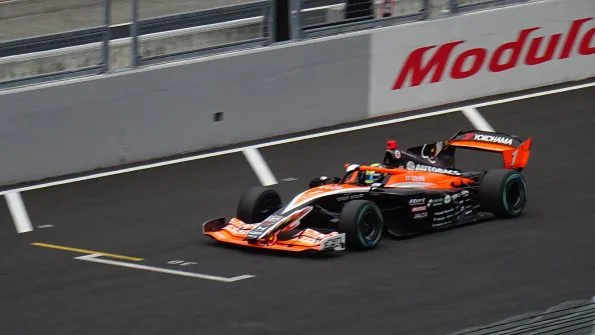
Super Formula — officially the Japanese Super Formula Championship — is Japan's premier single-seater racing series, sanctioned by the Japan Automobile Federation and promoted by Japan Race Promotion. Every team runs the same Dallara SF23 chassis on Yokohama control tyres, with a choice of Honda or Toyota 2.0-litre turbocharged engines producing around 550 hp. It is widely regarded as the fastest formula category in the world outside Formula 1, and its grid is made up largely of paid professional factory drivers rather than pay drivers.
Japan’s national top-formula championship started in 1973 as the All-Japan Formula 2000 Championship, became the All-Japan Formula Two Championship in 1978, and switched again to All-Japan Formula 3000 in 1987.
Japan Race Promotion took over in 1996 and renamed the series Formula Nippon. It ran as an open formula until 2002 — teams could choose between Lola, Reynard and G-Force chassis — before moving to a single spec chassis. The Super Formula name arrived in 2013.
The current Dallara SF23 is a revised SF19 with new aerodynamics aimed at closer wheel-to-wheel racing. It was unveiled on 13 December 2022 and has raced since the 2023 season, which was also the championship’s 50th.
A single-make series with two engine makers, run almost entirely in Japan for professional factory drivers.
A 677 kg car with around 550 hp and high downforce, quick enough that its lap times sit closer to Formula 1 than to any other single-seater category.
One chassis, two engine suppliers. Honda's HR-417E and Toyota's TRD-01F are detuned relatives of the units that race in Super GT's GT500 class.
Push-to-pass by another name: OTS releases an extra five kilograms per hour of fuel flow for up to 200 seconds of a race, and managing it is a core part of race strategy.
The field is mostly paid factory drivers rather than juniors buying seats, and since 2023 the Yokohama ADVAN control tyre has been built from roughly 33% sustainable material.
Track time before qualifying, with most weekends compressed into two days.
An F1-style Q1–Q2–Q3 shootout. Q1 runs in two groups with the fastest 12 going through to Q2, and the top three on the grid score bonus points.
Roughly 180 km, between 31 laps at Suzuka and 51 at SUGO, with one pit window per race and the Overtaking System to fight with.
For 2026 both races of a double-header run to the same distance, and the pit window is set per circuit — somewhere between laps 8 and 13 — instead of lap 10 everywhere. The two single-race weekends take only the top five from Q2 into Q3.
| Pos | Points | Pos | Points |
|---|---|---|---|
| 1st | 20 | 6th | 5 |
| 2nd | 15 | 7th | 4 |
| 3rd | 11 | 8th | 3 |
| 4th | 8 | 9th | 2 |
| 5th | 6 | 10th | 1 |
The Overtaking System and the pit window change where a driver finishes rather than awarding anything directly, and the Teams' Championship combines both of a team's cars.
| Round | Race | Circuit | Date |
|---|---|---|---|
| 01 | Motegi Race 1 | Mobility Resort Motegi, Tochigi | 4 April |
| 02 | Motegi Race 2 | Mobility Resort Motegi, Tochigi | 5 April |
| 04 | Suzuka Race 1 | Suzuka International Racing Course, Mie | 23 May |
| 05 | Suzuka Race 2 | Suzuka International Racing Course, Mie | 24 May |
| 06 | Fuji Race 1 | Fuji Speedway, Shizuoka | 18 July |
| 03 | Autopolis makeup race | Fuji Speedway, Shizuoka | 19 July |
| 07 | Fuji Race 2 | Fuji Speedway, Shizuoka | 19 July |
| 08 | SUGO | Sportsland SUGO, Miyagi | 9 August |
| 09 | Fuji Race 1 | Fuji Speedway, Shizuoka | 10 October |
| 10 | Fuji Race 2 | Fuji Speedway, Shizuoka | 11 October |
| 11 | Suzuka Race 1 | Suzuka International Racing Course, Mie | 21 November |
| 12 | Suzuka Race 2 | Suzuka International Racing Course, Mie | 22 November |
Last updated: 7 September 2026. Round 3 was due to run at Autopolis on 25 April but was postponed for weather and held at Fuji in July, which is why the round numbers are out of sequence. Eight of the twelve races are complete; Kakunoshin Ohta leads on 105 points from Ayumu Iwasa on 59.5.
Japan crowns its first national top-formula champion, Motoharu Kurosawa.
The championship adopts the international Formula Two regulations of the day.
A move to 3.0-litre F3000 machinery for what becomes one of the world's strongest national series.
Japan Race Promotion takes over as promoter and renames the championship.
Teams stop choosing between Lola, Reynard and G-Force, and the series moves to a single spec chassis.
The current name arrives, and Naoki Yamamoto wins the first title under it with Team Mugen.
Yokohama Rubber replaces Bridgestone as the sole tyre supplier.
A new Dallara brings halo cockpit protection to the series.
The revised Dallara SF23 debuts with aerodynamics aimed at closer racing.
Japan's national top formula grows from 2.0-litre machinery into the international Formula Two ruleset.
3.0-litre engines and a grid that regularly drew visiting European talent to Suzuka and Fuji.
Lola, Reynard and G-Force chassis raced side by side under multiple engine and tyre suppliers.
A single chassis replaces the open formula, and Bridgestone supplies the whole field.
A 2.0-litre single-turbo four making around 543 hp in a 660 kg car, with Yokohama replacing Bridgestone from 2016.
Halo cockpit protection and a 670 kg car, unveiled at Suzuka in October 2017.
A revised SF19 with new aerodynamics: 550 hp, 677 kg, Yokohama ADVAN control tyres.
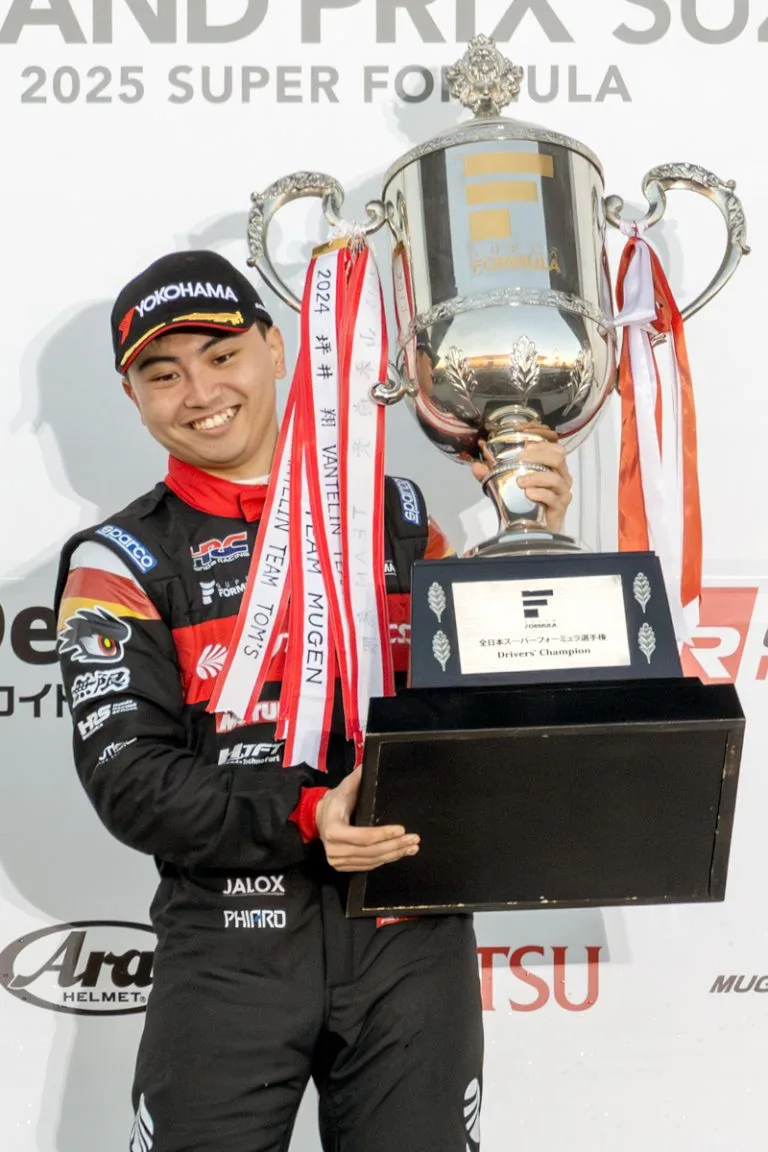
2025 Super Formula Champion · Team Mugen · 2024 Rookie of the Year, champion in his second season
Six Japanese top-formula championships across F2000, F2 and F3000, and 39 race wins — still the most of anyone.
Four Formula Nippon titles, the most by any driver since JRP took over the championship in 1996.
Champion in 2013, 2018 and 2020, and the most successful driver of the Super Formula era.
Back-to-back titles in 2021 and 2022 with Team Mugen, and still on the grid in 2026.
2024 champion with Vantelin Team TOM'S, the second of the team's back-to-back drivers' titles in 2023 and 2024.
2019 champion with Vantelin Team TOM'S, now a Formula E race winner with Jaguar TCS Racing.
2017 Rookie of the Year with two wins for Team Mugen, beaten to the title by half a point before reaching Formula 1.
2019 Rookie of the Year, who went on to win five IndyCar championships.
Japan Race Promotion becomes promoter and rebrands the championship Formula Nippon, beginning the modern era.
Chassis competition between Lola, Reynard and G-Force gives way to a single spec car, cutting costs and closing up the grid.
A rebrand aimed squarely at international recognition for what was already one of the fastest categories in the world.
Pierre Gasly takes Rookie of the Year and two wins, then misses the title by half a point when the Suzuka finale is cancelled for a typhoon.
The SF23 arrives for the anniversary year with aerodynamics designed to make overtaking possible again.
Double-headers now run to matched distances with per-circuit pit windows, and a washed-out Autopolis round is folded into a three-race Fuji weekend.
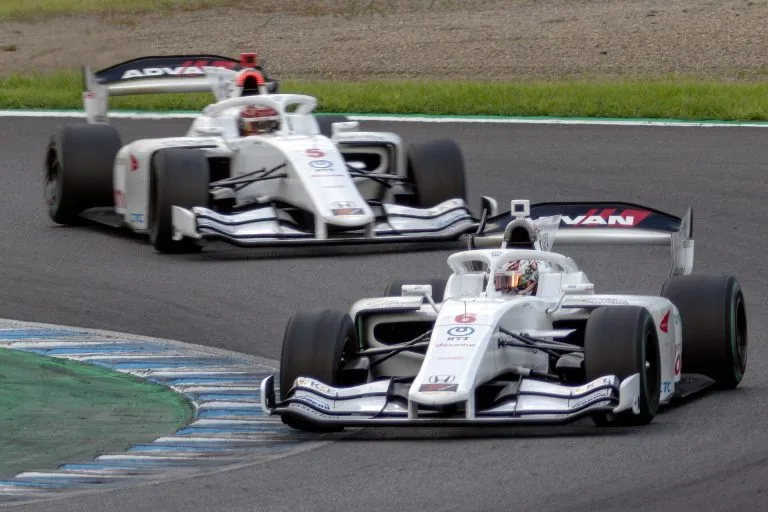
Honda · 2025 Teams' Champion, and leading 2026 on 133 points with four races to run
Japan's premier single-seater championship, officially the Japanese Super Formula Championship, sanctioned by the JAF and promoted by Japan Race Promotion. Every car is a Dallara SF23 with either a Honda or a Toyota turbo engine.
By lap time, yes — the SF23 makes around 550 hp in a 677 kg car with heavy downforce, and it is generally the quickest formula category in the world outside F1.
The championship dates to 1973 as the All-Japan Formula 2000 Championship. It became All-Japan Formula Two in 1978, All-Japan Formula 3000 in 1987, Formula Nippon in 1996, and Super Formula in 2013.
Yes, it is the same championship. Formula Nippon was the name used from 1996 to 2012; Super Formula replaced it in 2013.
No. Super GT is Japan's top sports-car championship for GT500 and GT300 machinery. The two share engine technology — Super Formula's engines are detuned relatives of the GT500 units — and many drivers race in both.
The Dallara SF23, used since 2023, with a 2.0-litre single-turbocharged DOHC inline-four from either Honda (HR-417E) or Toyota (TRD-01F). It weighs 677 kg with the driver and runs Yokohama ADVAN control tyres.
Super Formula's push-to-pass. OTS gives the driver an extra five kilograms per hour of fuel flow for up to 200 seconds during a race, and when to spend it is a real strategic decision.
Race winners take 20 points, then 15-11-8-6-5-4-3-2-1 to tenth. Qualifying pays 3-2-1 to the top three. If less than 75% of a race distance is run, half points are awarded.
Sixteen teams entered the 2026 championship, with the larger operations running two cars and several entering one.
Entirely in Japan. The 2026 season visits five circuits: Mobility Resort Motegi, Suzuka, Fuji Speedway, Sportsland SUGO and Autopolis.
After eight of twelve races, Kakunoshin Ohta leads on 105 points from Ayumu Iwasa on 59.5 and Nirei Fukuzumi on 58. Docomo Team Dandelion Racing leads the Teams' Championship on 133.
Kazuyoshi Hoshino won six Japanese top-formula championships across the F2000, F2 and F3000 eras. Naoki Yamamoto has three under the Super Formula name, and Satoshi Motoyama four in the Formula Nippon era.
Michael Schumacher, Eddie Irvine, Ralf Schumacher, Pedro de la Rosa, Stoffel Vandoorne, Pierre Gasly and Liam Lawson all raced in the championship or its predecessors. Álex Palou, Felix Rosenqvist and Pato O'Ward went on to win in IndyCar.
No. Unless a product page explicitly states otherwise, Kozmozracing is an independent store and is not affiliated with or endorsed by the JAF, Japan Race Promotion, Super Formula, any team or driver.
Independent fan guide: Formats, teams and calendars can change. Verify current sporting information with the JAF and the official SUPER FORMULA website directly. Championship, team and driver names belong to their respective rights holders.
No products are assigned to Super Formula yet. Add products to this series in the product editor.