Autobacs Super GT Series

SUPER GT

Japan's top sports car championship runs two classes of car in the same race, and hands out two kilograms of ballast for every point you score. Here is how GT500 and GT300 work, who leads in 2026, and why 2026 is the last season with a tyre war.

34thseason, from 1993
43cars, two classes
2 kgballast per point
Japan's top GT seriesTwo classes, one race650 hp, 2.0-litre turboSuccess Weight ballastCarbon-neutral GT500 fuel2026: the last tyre war
Super GT

What is Super GT?

Super GT is Japan's premier sports car championship, and one of very few major series anywhere that races two quite different classes of car at the same time. GT500 is the fast class: fourteen purpose-built silhouette cars entered by Toyota, Honda and Nissan, each powered by a two-litre turbocharged four making about 650 horsepower, quick enough to lap at roughly the pace of the fastest non-hybrid Le Mans prototypes, which makes GT500 the fastest production-based sports car racing in the world. GT300 is the bigger and far more varied class: twenty-nine cars in 2026, most of them Group GT3 machines from European manufacturers, mixed in with Japanese JAF-GT specials and low-cost Mother Chassis entries. Both classes share the track for every race, and much of the skill on display is in how GT500 drivers pick their way through GT300 traffic. The series began in 1993 as the All Japan Grand Touring Car Championship, the JGTC, and was renamed Super GT for 2005; it is sanctioned by the Japan Automobile Federation, run by the GT Association, and has had Autobacs as title sponsor since 1998. Its defining feature is Success Weight, which adds two kilograms of ballast for every point a car scores, so every good result makes the next race harder — in more than twenty seasons under the Super GT name, only two GT500 teams and one GT300 team have ever clinched a drivers' title before the final race.

Founded
1993, as the JGTC
Classes
GT500 and GT300
2026 season
8 rounds at 6 Japanese circuits
Run by
The GTA, sanctioned by the JAF
01 — Origins

Designed from day one to stop a runaway winner

The JGTC was created by the Japan Automobile Federation in 1993 to replace two series at once: the All Japan Sports Prototype Championship for Group C cars, and the Japanese Touring Car Championship for Group A touring cars, which moved to the Super Touring formula instead. Both had suffered from spiralling budgets and domination by a single team or make, and the new championship was built as a direct answer to that. It imposed strict limits on power and put heavy weight penalties on race winners, with the openly stated aim of keeping the on-track action close and the fans happy. That aim has never really changed.

The GT Association, the GTA, was set up in October 1993 to run the championship from 1994, and the two-class GT500 and GT300 structure arrived with it. Toyota, Nissan and Honda all built factory programmes for GT500, and the series grew steadily through the 1990s. It also went travelling: a round at Sepang in Malaysia was added in 2000, and a non-championship race was held at the California Speedway.

That overseas ambition is what eventually cost the series its name. For 2005 the JGTC planned a race at Shanghai on top of the existing Sepang round, but running in more than two countries would have cost it national championship status under the FIA’s International Sporting Code, and with it the right to keep All Japan Championship in its title. The series would instead be classified as an international championship. On 10 December 2004 the new name was confirmed as Super GT. The irony is that it has never actually held two overseas races in a season since; in theory it could still reclaim national status and return to JAF jurisdiction.

Engine
2.0-litre turbocharged inline-four
Engines used
Toyota RI4BG, Honda HR-420E, Nissan NR4S26
Power
About 650 hp
Weight
Over 1,020 kg with driver and fuel
Fuel
ETS Racing Fuels Renewablaze R100, carbon neutral, since 2023
Fuel flow
90.2 kg/h, reduced from 95 kg/h for 2026
Gearbox
Six-speed semi-automatic paddle shift
Fuel capacity
120 litres
Tyres
Bridgestone, Yokohama or Dunlop
02 — The essentials

Four things that make Super GT what it is

Two classes, three manufacturers in the top one, a ballast system that punishes success, and a tyre war that is about to end.

01

Two classes, one track

Every Super GT race is two championships running simultaneously. GT500 and GT300 start together, score separately, and spend the whole race interacting. The GTA has said it may have to look again at the speed gap between them, because GT500 cars are finding it harder and harder to get past GT300s as the smaller class gets quicker.

02

GT500 has no privateers

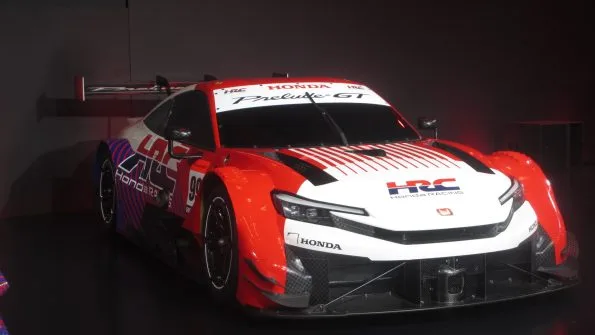
The top class is made up entirely of manufacturer-supported teams representing Toyota, Honda and Nissan. In 2026 that is fourteen cars: six Toyota GR Supras, five Honda entries running the brand-new HRC Prelude-GT, and three Nissan Zs. There is no way to buy your way in.

03

GT300 takes almost anything

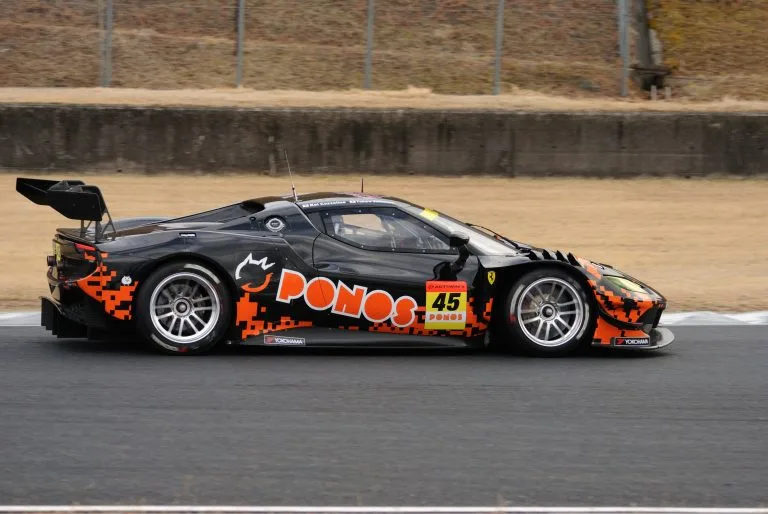
The second class mixes Group GT3 cars from Ferrari, Mercedes-AMG, Porsche, BMW, Lamborghini, Aston Martin, Nissan and Lexus with JAF-GT machines built to Japanese rules, and Mother Chassis cars — a standard Dome-built tub and a GTA-supplied Nissan V8 wearing the bodywork of a road car. Performance is levelled by balance-of-performance adjustments made race by race, and the data is published.

04

Success Weight

Score a point, carry two kilograms. The ballast is displayed on a sticker on every car, and it is why the championship almost always goes to the final round. Weight penalties on winners were part of the founding 1993 rulebook, and the modern version has grown into a graduated system of ballast, reduced fuel flow and slower refuelling.

03 — A race weekend

How a Super GT race is run

Distance

300 kilometres, or three hours

Most rounds are sprints of 250 to 300 kilometres. In 2022 the series added a longer 450-kilometre format with two compulsory stops, and in 2024 it ran its first time-based races. The 2026 calendar has four 300-kilometre races and two three-hour races.

The pit stop

One stop, two drivers

Every car is shared by at least two drivers, and a 300-kilometre race carries one compulsory pit stop in the middle for the driver change and refuelling. No single driver may cover more than two-thirds of the race distance, which stops teams turning the stop into a strategic weapon.

The stickers

Ballast on display

Each car carries a sticker showing its current Success Weight, so anyone in the grandstand can see who is carrying what. Once a GT500 car passes 50 kilograms the penalty stops being weight and becomes reduced fuel flow, then a restrictor that makes refuelling slower.

GT500, GT300 and Le Mans are more closely linked than they look: GT300 GT3 cars and the GT500 formula both sit inside the wider set of regulations that feed sports car racing worldwide, and a long list of Super GT graduates — Kamui Kobayashi, Ryo Hirakawa, Kazuki Nakajima, Benoit Treluyer, Andre Lotterer and Loic Duval among them — went on to win Le Mans and world endurance titles.

04 — How points are scored

Two classes, two different scales

PosGT500GT300
1st 20 25
2nd 15 20
3rd 11 16
4th 8 13
5th 6 11
6th 5 10
7th 4 9
8th 3 8
9th 2 7
10th 1 6
11th – 5
12th – 4
13th – 3
14th – 2
15th – 1
Pole 1 1

Success Weight

Every point a car scores adds two kilograms of ballast. The system used to work off qualifying positions and lap times as well; today it is purely points-based, and the running total is printed on a sticker on the car for anyone to read.

For 2026 the GT500 version escalates in four bands. Up to 50 kg the penalty is simply weight. Between 51 and 67 kg the ballast stays capped at 50 kg but engine fuel flow drops from 90.2 to 88.0 kg/h. Above 67 kg a success refuelling restrictor is fitted to lengthen pit stops, 21 mm from 68 kg and 19 mm above 84 kg. GT300 began folding refuelling time into its own formula in 2025.

It unwinds at the end of the year: ballast is halved for the penultimate round and removed altogether for the finale, for any team that has entered every round. That rule dates from 2009 and exists to kill sandbagging. In 2003 neither the GT500 nor the GT300 champion had won a single race, and deliberately underperforming to earn a lighter car had become a viable tactic.

The teams' championships use the same finishing scales but score differently: there is no point for pole, and instead a completion bonus of 3, 2 or 1 depending on how many laps down a car finishes. The bands are one lap more generous in GT300 than in GT500, which reflects a class that spends its race being lapped by faster traffic. Fastest lap pays nothing in either championship.

05 — The season

2026 calendar

Round 5 at Sportsland Sugo on 19-20 September 2026.
Rd Race Circuit Date
1 Okayama GT 300 km Okayama International Circuit 11-12 April
2 Fuji GT 3 Hours, Golden Week special Fuji Speedway 3-4 May
3 Fuji GT 300 km Fuji Speedway 1-2 August
4 Suzuka GT 300 km Suzuka Circuit 22-23 August
5 Sugo GT 300 km Sportsland Sugo 19-20 September
6 Autopolis GT 3 Hours Autopolis 17-18 October
7 Motegi GT Race 1 Mobility Resort Motegi 7-8 November
8 Motegi GT Race 2 Mobility Resort Motegi 7-8 November

Eight rounds across seven weekends at six circuits, every one of them in Japan. The Sepang round in Malaysia, scheduled for 20-21 June and only restored to the calendar in 2025, was cancelled before the season began because of the war in the Middle East and rising fuel costs. On 2 August 2026 the GTA replaced it by giving Motegi two races on one weekend, which is why rounds 7 and 8 share a date. For the first time since the overseas era began, Super GT is racing exclusively at home.

06 — History

From the JGTC to the end of the tyre war

1993

The JGTC is founded

The Japan Automobile Federation creates the All Japan Grand Touring Car Championship to replace the Group C prototype and Group A touring car series, with power limits and weight penalties for winners written in from the start. The GT Association is established that October to run it.

1994

Two classes from the beginning

GT500 and GT300 are introduced together in the first GTA-run season. Toyota, Nissan and Honda all commit factory efforts to the top class.

1996

The only foreign champion

The BMW-powered McLaren F1 GTR wins both the drivers' and teams' championships — the only foreign-built car ever to take the GT500 drivers' title. A Porsche 911 GT2 had won the teams' title the year before.

2005

Renamed Super GT

Plans for a second overseas round cost the series its FIA national championship status, and with it the right to call itself an All Japan championship. The new name is confirmed on 10 December 2004.

2014

Class 1, with the DTM

Super GT and Germany's DTM announce a shared technical formula so manufacturers could race in both with one car. New GT500 cars arrive with 2.0-litre turbo fours, over sixty common parts and 30 per cent more downforce, and the Honda NSX Concept-GT becomes the first hybrid in the class.

2020

Class 1 fully implemented

The regulations finally align completely, with a standard ECU and suspension. It lasts one season: the DTM abandons the formula for GT3 cars in 2021 after a manufacturer exodus, and Super GT keeps the rules but drops the Class 1 name.

2023

Carbon-neutral fuel in GT500

The top class switches from 102 RON petrol to ETS Racing Fuels Renewablaze R100. GT300 continues on 102 RON unleaded.

2026

The last tyre war

Announced in October 2025: this is the final season in which rival tyre manufacturers compete against each other. From 2027 each class runs a single supplier.

07 — The machinery

What actually races, class by class

GT500

Silhouette cars, three makers

Purpose-built carbon monocoques wearing production bodyshells, with a 2.0-litre single-turbo four making about 650 hp and weighing over 1,020 kg. Front-engine, rear-wheel drive has been the only permitted layout since 2010. For 2026 the three cars are the Toyota GR Supra, the Nissan Z and the new HRC Prelude-GT, which replaced Honda's Civic Type R-GT after two seasons.

GT300 — GT3

The European contingent

Most of the class is Group GT3 machinery, eligible since 2010 and now the default choice: Ferrari 296 GT3, Mercedes-AMG GT3, Porsche 911 GT3 R, BMW M4 GT3, Lamborghini Huracan, Aston Martin, plus GT3 versions of the Nissan GT-R and Lexus RC F. Audi and BMW have run works-supported entries.

GT300 — JAF-GT

Built to Japanese rules

Cars homologated to the JAF's own GT regulations, which allow much greater deviation from the road car than GT3 does. The Toyota Prius and Subaru BRZ are the best-known examples. For 2026 R&D Sport swapped its BRZ's four-cylinder EJ20 for the six-cylinder EG33 from the 1990s Subaru Alcyone SVX.

GT300 — Mother Chassis

A tub with a badge on it

When specialist Japanese constructors began disappearing from the class, the GTA worked with Dome to build a low-cost standard platform: a Dome-made tub and a GTA-branded Nissan VK45DE V8 under the styling of a production car. The first ran in 2014 and a Toyota 86 MC won the GT300 title in 2016.

08 — The drivers

Who to watch in 2026

Sho Tsuboi and Kenta Yamashita
GT500 champions and 2026 leaders

Sho Tsuboi and Kenta Yamashita

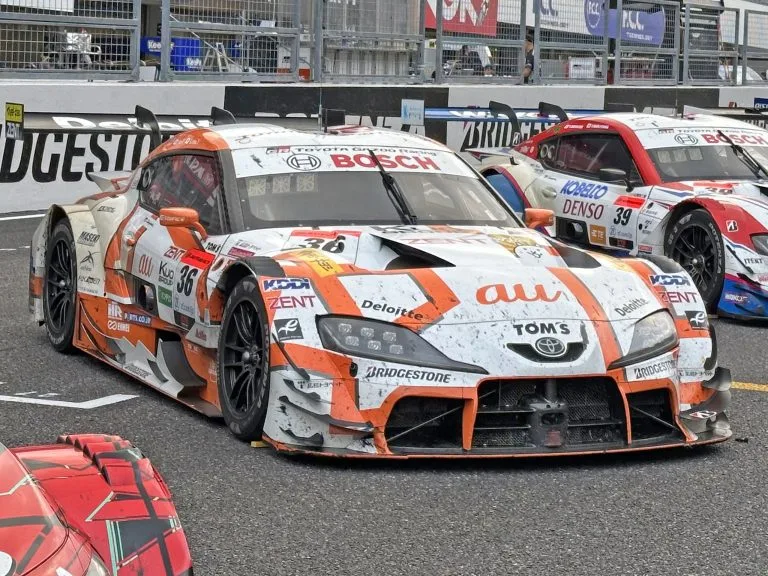
No. 36 TGR Team au TOM'S, Toyota GR Supra. Champions together in 2024 and 2025, and on 50 points after four rounds they lead by 17. Behind them the class is packed: second to sixth covers just six points, with three cars tied on 27. Tsuboi's four GT500 titles tie Ronnie Quintarelli's all-time record.

01

Sho Tsuboi

Leads GT500 with Kenta Yamashita in the No. 36 au TOM'S GR Supra, and has won the title in three consecutive years. His fourth GT500 championship in 2025 tied the all-time record. He is also the 2024 Super Formula champion and a former Japanese F3 and F4 champion.

Four GT500 titles, 2021 and 2023-2025
02

Kenta Yamashita

Tsuboi's team-mate and co-champion in 2024 and 2025, with three Super GT titles of his own. The pair have won two rounds of 2026 between them and lead the standings by 17 points.

Three Super GT titles
03

Naoki Yamamoto

Won the 2020 GT500 title with Tadasuke Makino for Team Kunimitsu, and the pair still share the No. 100 Stanley car, where they took the Fuji 300 km win in August. A two-time Super Formula champion who has also driven a Formula 1 practice session.

2020 GT500 champion
04

Tomoki Nojiri

Second in GT500 for ARTA Mugen after winning at Suzuka, partnered by Ren Sato. A double Super Formula champion in 2021 and 2022, he has not yet won a GT500 title — which makes him the most decorated driver in the class still chasing one.

Super Formula champion, 2021-2022
05

Joao Paulo de Oliveira

Leads GT300 with Iori Kimura for Kondo Racing, the team he won the class with in both 2020 and 2022. The Brazilian is also a former Formula Nippon and All-Japan F3 champion, and still races in the world endurance championship.

Two GT300 titles, 2020 and 2022
06

Miki Koyama

Came to Super GT from two seasons in W Series, joined Toyota's driver academy in 2022, and in 2023 became the first woman to race in the championship since 2012. She is seventh in GT300 for apr alongside Kazuto Kotaka.

First woman in Super GT since 2012
07

Daniil Kvyat

The former Toro Rosso and Red Bull Formula 1 driver now races GT300 for JLOC in a Lamborghini, sharing with Takashi Kogure — one of only three drivers to have won championships in both Super GT classes.

2013 GP3 champion
08

Zak O'Sullivan

Third in GT300 for CarGuy MKS Racing at 21, the 2021 GB3 champion also races in Super Formula for Team Impul and is a Formula E reserve driver for Envision. A useful illustration of how Japanese racing has become a career route again.

2021 GB3 champion
09

Nobuteru Taniguchi

Shares the No. 4 Goodsmile Racing car with Tatsuya Kataoka — which puts the two men who jointly hold the GT300 title record in the same car. Taniguchi is also a D1 Grand Prix drifting champion.

Three GT300 titles since 2005
09 — Turning points

Four decisions that shaped the series

01

Weight penalties were there from the start

Most championships add success ballast later, as a fix. Super GT was designed around it: the 1993 rulebook capped power and penalised race winners specifically to prevent the budget spirals and single-team domination that had killed the two series it replaced. Everything distinctive about Super GT follows from that founding choice.

02

Giving up the national championship

Wanting a second overseas race meant losing FIA national championship status and the All Japan name. The series took the trade and became Super GT for 2005 — then never held two overseas races in a season. In 2026, with Sepang cancelled, it holds none at all.

03

The Class 1 alliance with the DTM

Aligning GT500 with the DTM promised manufacturers one car for two continents, and produced a genuine one-off: the 2019 Super GT x DTM Dream Race, where Audi RS5 and BMW M4 DTM cars raced in Japan. Full alignment arrived in 2020 and the DTM walked away in 2021. Super GT kept the cars and quietly dropped the name.

04

The end of the tyre war

An open tyre war between Bridgestone, Yokohama, Dunlop and Michelin is part of why GT500 got so fast. It is also lopsided: in 2026 Bridgestone supplies twelve of the fourteen GT500 cars while Yokohama supplies seventeen of twenty-nine in GT300. From 2027 each class runs a single supplier, and one of the series' defining variables disappears.

10 — GT500 Teams' Championship

Where the top class stands after four of eight rounds

GT300
The other championship

GT300

GT300 is a separate championship with its own points scale, and it is far tighter than GT500. After four rounds Kondo Racing's No. 56 leads on 49 points with Joao Paulo de Oliveira and Iori Kimura, one ahead of D'station Racing's Aston Martin on 48 and five ahead of CarGuy MKS Racing's Ferrari on 44. Four rounds have produced four different winning teams. The defending champions, K2 R&D LEON Racing, are eighth.

#1 36 TGR Team au TOM'SToyota GR Supra · Bridgestone · 62 pts
#2 16 ARTA MugenHonda HRC Prelude-GT · Bridgestone · 45 pts
#3 14 TGR Team ENEOS ROOKIEToyota GR Supra · Bridgestone · 42 pts
#4 100 Stanley Team KunimitsuHonda HRC Prelude-GT · Bridgestone · 39 pts
#5 8 Team HRC ARTA MugenHonda HRC Prelude-GT · Bridgestone · 36 pts
#6 38 TGR Team KeePer CerumoToyota GR Supra · Bridgestone · 36 pts
#7 17 Astemo Real RacingHonda HRC Prelude-GT · Bridgestone · 34 pts
#8 23 NISMONissan Z · Bridgestone · 31 pts
#9 12 Team ImpulNissan Z · Bridgestone · 31 pts
#10 39 TGR Team SARDToyota GR Supra · Bridgestone · 26 pts
#11 24 Kondo RacingNissan Z · Bridgestone · 23 pts
#12 37 TGR Team Deloitte TOM'SToyota GR Supra · Bridgestone · 19 pts
#13 19 TGR Team WedsSport BandohToyota GR Supra · Yokohama · 10 pts
#14 64 Modulo Nakajima RacingHonda HRC Prelude-GT · Dunlop · 6 pts
11 — Questions

Super GT, answered

What is Super GT?

Japan's premier sports car championship, running two classes — GT500 and GT300 — in the same race. It was founded in 1993 as the All Japan Grand Touring Car Championship and renamed Super GT for 2005.

What is the difference between GT500 and GT300?

GT500 is the faster class: fourteen manufacturer-run silhouette cars from Toyota, Honda and Nissan with about 650 hp. GT300 is larger and more varied — twenty-nine cars in 2026, mostly Group GT3 machines from European makers, plus Japanese JAF-GT cars and low-cost Mother Chassis entries. They score separate championships on different points scales.

Why was Super GT called the JGTC?

Because it was the All Japan Grand Touring Car Championship, sanctioned as a national championship. When the series planned races in more than two countries it would have lost FIA national status and the right to the All Japan name, so it was renamed Super GT, confirmed on 10 December 2004.

What is Success Weight?

Ballast added according to how many points a car has scored, at two kilograms per point, displayed on a sticker on the car. Above 50 kg in GT500 the penalty becomes reduced fuel flow and then a restrictor that slows refuelling. It is halved for the penultimate round and removed for the finale for teams that have entered every round.

Does Success Weight actually work?

Yes. In more than twenty seasons under the Super GT name only two GT500 teams — ARTA in 2007 and MOLA in 2012 — and one GT300 team have clinched a drivers' title before the final race. In 2007 the Takata NSX took five poles in the first seven races and won just one of them.

How fast is a GT500 car?

Roughly as fast as the quickest non-hybrid Le Mans prototypes, which makes GT500 the fastest production-based sports car racing in the world. The cars use a 2.0-litre single-turbo four of about 650 hp in a purpose-built carbon monocoque weighing over 1,020 kg with driver and fuel.

Who leads Super GT in 2026?

After four of eight rounds, Sho Tsuboi and Kenta Yamashita lead GT500 on 50 points in the No. 36 au TOM'S Toyota GR Supra. Joao Paulo de Oliveira and Iori Kimura lead GT300 on 49 points for Kondo Racing.

How many rounds are there in 2026?

Eight, across seven weekends at six circuits, all in Japan. Rounds 7 and 8 share one weekend at Motegi.

Why is there no overseas race in 2026?

The Sepang round in Malaysia, restored to the calendar only in 2025, was cancelled before the season started because of the war in the Middle East and rising fuel costs. The GTA replaced it on 2 August 2026 by giving Motegi a second race on the same weekend.

What is the Mother Chassis?

A low-cost standard GT300 platform created by the GTA with the constructor Dome, after specialist Japanese entries began dying out. It pairs a Dome-built tub and a GTA-supplied Nissan VK45DE V8 with the bodywork of a production car. The first raced in 2014 and a Toyota 86 MC won the 2016 GT300 title.

What fuel does Super GT use?

GT500 has run ETS Racing Fuels Renewablaze R100 carbon-neutral fuel since 2023, having used 102 RON petrol from 2014 to 2022. GT300 still runs 102 RON unleaded — the carbon-neutral fuel applies to the top class only.

Why is 2026 the last tyre war?

The GTA announced in October 2025 that 2026 would be the final season with rival tyre makers competing, and that each class would move to a single supplier from 2027. The current war is already very one-sided: Bridgestone shoes twelve of fourteen GT500 cars, while Yokohama supplies seventeen of twenty-nine in GT300.

Has a Formula 1 world champion won Super GT?

Yes. Jenson Button, the 2009 Formula 1 champion, won the 2018 GT500 title with Team Kunimitsu in his first full season. Heikki Kovalainen won GT500 in 2016. Daniil Kvyat currently races in GT300 for JLOC.

What is Class 1?

A shared technical formula agreed by Super GT and the DTM in 2014 so that manufacturers could use one car in both. It was fully implemented in 2020, the DTM abandoned it for GT3 cars in 2021, and Super GT kept the regulations but stopped using the name.

Who holds the Super GT records?

Ronnie Quintarelli and Sho Tsuboi share the GT500 record with four drivers' titles each. In GT300, Tatsuya Kataoka and Nobuteru Taniguchi have three titles each since 2005 and are tied with Morio Nitta and Tetsuya Yamano for the most including the JGTC era. Three drivers have won in both classes: Masataka Yanagida, Kazuya Oshima and Takashi Kogure.

Sources

Kozmoz Racing is an independent fan store. We are not affiliated with, endorsed by or sponsored by the GT Association, the Japan Automobile Federation, Autobacs or any Super GT team or manufacturer.

12 — Shop

Super GT collection

No products are assigned to Super GT yet. Add products to this series in the product editor.

0 View cart