Three phases, not one season
Rounds 1 to 9 are the Sprint Cup, rounds 10 and 11 the Enduro Cup, and rounds 12 to 14 a Finals Series. Ten drivers qualify for the finals, which run as knockouts across the last three rounds.

Front-engined V8 touring cars, thirty-seven races across Australia and New Zealand, and one weekend in October at Mount Panorama that the whole country stops for.
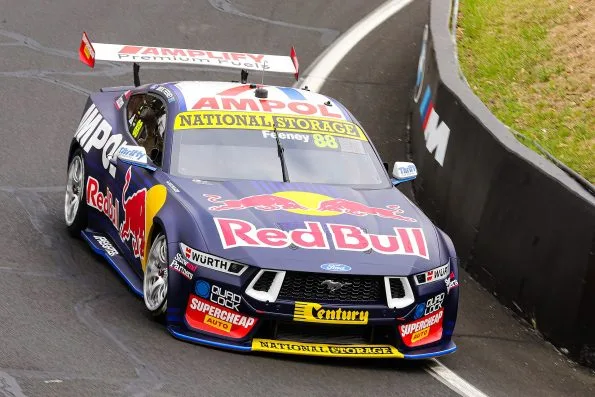
The Supercars Championship — commercially the Repco Supercars Championship, and known as V8 Supercars from 1996 until 2016 — is Australia's premier motorsport series, a touring car championship raced across Australia and New Zealand and FIA-sanctioned as an international series since 2011. Cars are front-engined, rear-wheel-drive V8s built to the Gen3 rules introduced in 2023: the Ford Mustang GT, the Chevrolet Camaro ZL1 and, new for 2026, the Toyota GR Supra, all on Dunlop control tyres. Its crown jewel is the Bathurst 1000 at Mount Panorama. The 2026 season is the 28th Supercars Championship, the 30th in which Supercars have contested the Australian Touring Car Championship, and the 67th season of touring car racing in Australia.
Australian touring car racing has crowned a national champion since 1960, and the Bathurst enduro at Mount Panorama started the same year as the Armstrong 500. For decades the Australian Touring Car Championship was a Holden-versus-Ford argument settled at Bathurst every October, and it is where Peter Brock built a nine-win record at the Great Race that still stands.
The V8 formula came first and the name came after. CAMS confirmed a class structure in June 1992 built around Australian-made 5.0-litre V8 Fords and Holdens, which is what made the turbocharged Nissan Skyline GT-R and Ford Sierra RS500 ineligible. In November 1996 the teams’ own body, TEGA, formed the Australian Vee Eight Super Car Company with IMG and the Australian Motor Sports Commission to run the series — and the category took the name V8 Supercars, even though the cars barely changed.
What changed was the business. The series raced as the Shell Championship Series from 1999, the V8 Supercar Championship Series from 2002, the International V8 Supercars Championship from 2011, then under Virgin Australia from 1 July 2016 and Repco since 2021 — while contesting the Australian Touring Car Championship title throughout. The championship expanded with it: Hidden Valley in 1998, an Adelaide street race in 1999, Canberra in 2000, New Zealand in 2001 and the Gold Coast in 2002. The endurance races began counting for the championship in 1999, control tyres arrived the same year, and the Top Ten Shootout was used at every round from 2001.
The cars are now Gen3, introduced in 2023 to cut costs and bring the silhouettes closer to showroom shapes. Toyota joined Ford and Chevrolet for 2026 with the GR Supra, giving the championship three manufacturers for the first time in its modern era.
A season in three distinct phases, and a points system built around one number.
Rounds 1 to 9 are the Sprint Cup, rounds 10 and 11 the Enduro Cup, and rounds 12 to 14 a Finals Series. Ten drivers qualify for the finals, which run as knockouts across the last three rounds.
The points scale changes with the number of races at an event — a win pays 60, 75, 120 or more — set so that sweeping every race at any event scores exactly 300. No round is worth more than another.
161 laps and 1,000 kilometres of Mount Panorama over six or seven hours, run since 1960 and watched by crowds approaching 200,000. Both drivers of a car score the full points for the finishing position.
Ford Mustang, Chevrolet Camaro and, from 2026, Toyota GR Supra — different bodies over the same Gen3 architecture, front-engined and rear-wheel-drive, on control tyres.
A Super 440 or SuperSprint weekend packs three or four races into two days, each with its own qualifying.
The Bend 500 and the Bathurst 1000 are co-driven, and both drivers take the full points scored by the car.
The last three rounds are run as knockout events among the ten drivers who qualified, deciding the championship at Adelaide.
To score, a car must complete 75% of the race distance and be running at the finish; at least 50% of the planned distance must be run for a result to count at all.
| Pos | Main race | Short race |
|---|---|---|
| 1st | 120 | 60 |
| 2nd | 110 | 55 |
| 3rd | 102 | 51 |
| 4th | 93 | 47 |
| 5th | 86 | 43 |
| 6th | 79 | 40 |
| 7th | 73 | 36 |
| 8th | 67 | 33 |
| 9th | 62 | 31 |
| 10th | 57 | 28 |
The two columns above are the scales used at three-race rounds — the short opening race, then the two longer ones. Other event formats use their own scale to reach the same 300-point maximum.
| Round | Phase | Event | Dates |
|---|---|---|---|
| 01 | Sprint Cup | Sydney 500, Sydney Motorsport Park | 20–22 February |
| 02 | Sprint Cup | Melbourne SuperSprint, Albert Park | 5–8 March |
| 03 | Sprint Cup | Taupō Super 440, New Zealand | 10–11 April |
| 04 | Sprint Cup | Christchurch Super 440, New Zealand | 17–19 April |
| 05 | Sprint Cup | Tasmania Super 440, Symmons Plains | 22–24 May |
| 06 | Sprint Cup | Darwin Triple Crown, Hidden Valley | 19–21 June |
| 07 | Sprint Cup | Townsville 500, Reid Park | 10–12 July |
| 08 | Sprint Cup | Perth Super 440, Wanneroo Raceway | 31 July – 2 August |
| 09 | Sprint Cup | Ipswich Super 440, Queensland Raceway | 21–23 August |
| 10 | Enduro Cup | The Bend 500, Tailem Bend | 11–13 September |
| 11 | Enduro Cup | Bathurst 1000, Mount Panorama | 8–11 October |
| 12 | Finals | Gold Coast 500, Surfers Paradise | 23–25 October |
| 13 | Finals | Sandown 500, Sandown Raceway | 6–8 November |
| 14 | Finals | Adelaide Grand Final, Adelaide Street Circuit | 26–29 November |
Last updated: 7 September 2026. Fourteen rounds and 37 races. The Sprint Cup is complete — Broc Feeney won it for the second year running, and Ford has already taken the Manufacturers' Championship. Race 10 at Christchurch was postponed when Cyclone Vaianu hit. The Enduro Cup starts at The Bend this weekend, and the title is settled at Adelaide in November.
The first Australian Touring Car Championship is run, and Mount Panorama holds the first Bathurst enduro as the Armstrong 500.
Peter Brock wins the Great Race nine times, a record that still stands, and turns Bathurst into a national event.
CAMS confirms the class structure in June: Class A for Australian-built 5.0-litre V8 Fords and Holdens, which makes the turbocharged Nissan Skyline GT-R and Ford Sierra RS500 ineligible from 1993.
The Australian Vee Eight Super Car Company is formed in November by the teams' own body TEGA with IMG and the Australian Motor Sports Commission. The category takes the name V8 Supercars — the cars themselves barely change.
Bathurst and Sandown are folded into the championship, control tyres arrive with Bridgestone, and the series races as the Shell Championship Series.
Shell's sponsorship ends and the V8 name moves into the series title. Dunlop replaces Bridgestone as control tyre supplier, and the Gold Coast Indy 300 support race becomes a championship round.
Supercars is recognised by the FIA and the series is retitled the International V8 Supercars Championship, opening the door to rounds beyond Australia and New Zealand.
A deal with Virgin Australia agreed in April renames the series on 1 July, mid-season — so 2016 is the last season titled International V8 Supercars and 2017 the first titled Supercars Championship.
New cars cut costs and bring the Mustang and Camaro closer to their showroom shapes.
Ten drivers now carry the championship into knockout rounds across the last three events.
The GR Supra joins Ford and Chevrolet, giving the championship three manufacturers.
Australian touring car rules of their own, then international Group A — the era of the Torana, the Falcon and Brock's Commodores.
A locally written formula settled on 5.0-litre V8 Holdens and Fords, restricted to 7,500 rpm, and the Holden-versus-Ford rivalry became the sport's identity.
A project led by Mark Skaife from 2008 aimed at a $250,000 car through control parts: a common chassis, independent rear suspension, a rear transaxle and the fuel tank moved ahead of the rear axle. Gen2 then permitted two-door coupés and turbocharged four- and six-cylinder engines from 2017 — no team ever built one to the alternate engine spec.
Lower, lighter cars with more showroom-accurate silhouettes and much less downforce, to cut the dirty air and make them harder to drive: the Mustang GT and the Camaro ZL1, joined by the GR Supra in 2026.
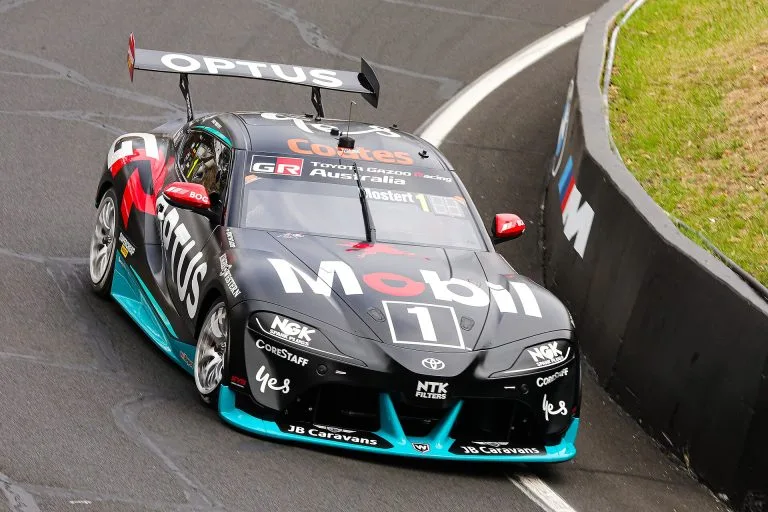
2025 Supercars Champion · Walkinshaw TWG Racing · eighth in the 2026 standings and into the Finals Series
Nine Bathurst 1000 wins, a record no one has approached. The winner's trophy has carried his name since 2006.
The most successful driver in the championship's history, and the benchmark every modern Supercars career is measured against.
Three-time Supercars champion from Auckland, now racing full-time in the NASCAR Cup Series for Trackhouse.
Won the 2026 Sprint Cup for the second year running and leads the standings on 2,107 points going into the enduros.
Second on 2,077 points for Grove Racing, the team leading the Teams' Championship.
Third on 1,878 points, and a former champion of the series.
Fourth on 1,852 points, and Ford's leading challenger in the year Ford took the Manufacturers' title.
Fifth on 1,793 points in only his second full season.
The Armstrong 500 at Phillip Island moves to Mount Panorama in 1963 and becomes the race the championship is built around.
AVESCO is formed in November by the teams' own body TEGA together with IMG and the Australian Motor Sports Commission. TEGA held 75% and set the rules and technical management; a separate company took the broadcasting, sponsorship and sanction rights. The championship has been run for and by its competitors ever since.
The series has been the Australian Touring Car Championship through 1998, the Shell Championship Series from 1999, the V8 Supercar Championship Series from 2002, the International V8 Supercars Championship from 2011, the Virgin Australia Supercars Championship from 1 July 2016 and the Repco Supercars Championship since 2021 — while the trophy has been the Australian Touring Car Championship the whole way through.
New cars, closer parity and lower costs, after years of argument about how much teams should be allowed to build themselves.
Toyota's arrival ends the two-brand era, while Cyclone Vaianu forces the postponement of a race at Christchurch.
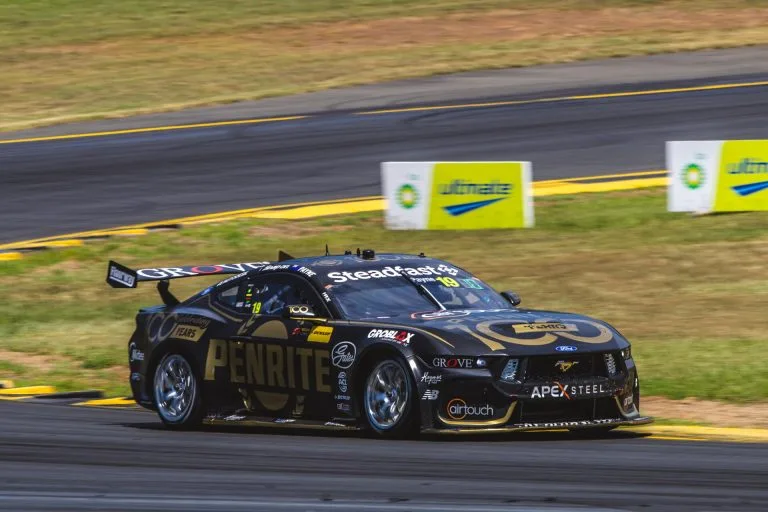
3,810 points, 67 clear of reigning Teams' Champions Triple Eight, with Matt Payne second in the drivers' standings
Australia's premier motorsport series, a touring car championship raced in Australia and New Zealand. It is commercially the Repco Supercars Championship and has been an FIA-sanctioned international series since 2011.
No, but it was for twenty years. The category took the V8 Supercars name in November 1996 when AVESCO was formed, carried it in the series title from 2002 as the V8 Supercar Championship Series and from 2011 as the International V8 Supercars Championship, and lost it on 1 July 2016 when a Virgin Australia deal renamed the series mid-season. V8s still race — the name went because the rules opened up, not the engines.
The same championship under an older name, not a separate series. V8 Supercars is what this championship was called from 1996 until the middle of 2016; the cars, the teams and the Bathurst 1000 all carried straight over, and the trophy has been the Australian Touring Car Championship the whole time.
Gen3 cars, introduced in 2023: the Ford Mustang GT, the Chevrolet Camaro ZL1 and, from 2026, the Toyota GR Supra. All are front-engined and rear-wheel-drive with V8 engines — 5.4 litres for Ford, 5.7 for Chevrolet and 5.2 for Toyota — on Dunlop control tyres.
The championship's most famous race: 161 laps and 1,000 kilometres of Mount Panorama, run over six or seven hours in October. It has been held since 1960, originally as the Armstrong 500, and draws crowds approaching 200,000.
Peter Brock, with nine. The winner's trophy has been named the Peter Brock Trophy since 2006.
Three phases. Rounds 1 to 9 are the Sprint Cup, rounds 10 and 11 the Enduro Cup, and rounds 12 to 14 a Finals Series. Ten drivers qualify for the finals, which run as knockout events across those last three rounds.
Different scales apply depending on how many races an event holds, arranged so that winning every race at any event is worth exactly 300 points. A three-race round pays 60 then 120 and 120; a four-race round pays 75 each time. Points go down to 25th, with five bonus points for the fastest lap.
Yes. At the endurance rounds both drivers of a car receive the full points for the car's finishing position.
Twenty-eight charter cars, with up to six additional wildcard entries permitted for the endurance races.
Broc Feeney, on 2,107 points from Matt Payne on 2,077. Feeney has already won the 2026 Sprint Cup and Ford has taken the Manufacturers' Championship; the drivers' title is decided in the Finals Series at Adelaide in November.
Chaz Mostert, who won the 2025 title. He sits eighth in 2026 and has qualified for the Finals Series.
Shane van Gisbergen, a three-time Supercars champion, races full-time in the NASCAR Cup Series for Trackhouse Racing. Marcos Ambrose made the same move a generation earlier.
Yes. New Zealand has two rounds in 2026, at Taupō and Christchurch, and the series has been FIA-sanctioned as an international championship since 2011.
No. Unless a product page explicitly states otherwise, Kozmozracing is an independent store and is not affiliated with or endorsed by Supercars, Repco, any team or driver.
Independent fan guide: Formats, calendars and regulations change. Verify current sporting information with Supercars directly. Championship, team and driver names belong to their respective rights holders.
No products are assigned to Supercars yet. Add products to this series in the product editor.