Purpose-built cars
Every team designs and develops its own car around a tightly controlled technical rulebook.

The cars, teams, drivers and split-second strategy behind the highest class of international single-seater racing.

Formula 1 is the highest class of international single-seater motor racing governed by the FIA. Teams design purpose-built cars and compete at Grand Prix events for the Drivers' and Constructors' Championships. The World Championship began in 1950 and combines driver skill, engineering, race strategy and pit-stop execution.
In 1946, international motor racing authorities agreed a new premier formula for post-war Grand Prix cars. Those rules became the foundation of the World Championship launched in 1950. The inaugural championship counted seven rounds, including the Indianapolis 500. The first championship Grand Prix was held at Silverstone on 13 May 1950, and Alfa Romeo driver Giuseppe Farina became the first World Champion.
Early Formula 1 was dominated by front-engined cars and Italian manufacturers. The sport then evolved through rear-engine design, aerodynamics, sponsorship, turbocharging, electronic control, hybrid power and increasingly sophisticated safety standards.
Formula 1 combines purpose-built cars, team engineering and race-weekend execution.
Every team designs and develops its own car around a tightly controlled technical rulebook.
Drivers score for themselves while both cars contribute points toward the Constructors' Championship.
Tyres, pit-stop timing, weather and safety-car periods can reshape a Grand Prix in seconds.
Street circuits, permanent tracks and night races create a different technical test each weekend.
Teams test set-up, learn tyre behaviour and collect data for qualifying and the race.
Drivers compete for the fastest lap time and their starting position for the Grand Prix.
Points are awarded at the finish, with strategy and reliability tested over the full distance.
Sprint events use a modified schedule with an additional shorter race. Session formats are subject to the current sporting regulations.
| Pos | Points | Pos | Points |
|---|---|---|---|
| 1st | 25 | 6th | 8 |
| 2nd | 18 | 7th | 6 |
| 3rd | 15 | 8th | 4 |
| 4th | 12 | 9th | 2 |
| 5th | 10 | 10th | 1 |
Points systems are set by the FIA and can change between seasons — always check the official regulations for the current rules.
| Round | Grand Prix | Circuit | Date |
|---|---|---|---|
| 01 | Australian GP | Albert Park Grand Prix Circuit | 6–8 March |
| 02 | Chinese GP | Shanghai International Circuit | 13–15 March |
| 03 | Japanese GP | Suzuka Circuit | 27–29 March |
| 04 | Miami GP | Miami International Autodrome | 1–3 May |
| 05 | Canadian GP | Circuit Gilles-Villeneuve | 22–24 May |
| 06 | Monaco GP | Circuit de Monaco | 5–7 June |
| 07 | Barcelona GP | Circuit de Barcelona-Catalunya | 12–14 June |
| 08 | Austrian GP | Red Bull Ring | 26–28 June |
| 09 | British GP | Silverstone Circuit | 3–5 July |
| 10 | Belgian GP | Circuit de Spa-Francorchamps | 17–19 July |
| 11 | Hungarian GP | Hungaroring | 24–26 July |
| 12 | Dutch GP | Circuit Zandvoort | 21–23 August |
| 13 | Italian GP | Autodromo Nazionale Monza | 4–6 September |
| 14 | Spanish GP | Madring | 11–13 September |
| 15 | Azerbaijan GP | Baku City Circuit | 24–26 September |
| 16 | Bahrain GP | Sepang International Circuit | 2–4 October |
| 17 | Singapore GP | Marina Bay Street Circuit | 9–11 October |
| 18 | United States GP | Circuit of The Americas | 23–25 October |
| 19 | Mexico City GP | Autódromo Hermanos Rodríguez | 30 Oct–1 Nov |
| 20 | São Paulo GP | Autódromo José Carlos Pace | 6–8 November |
| 21 | Las Vegas GP | Las Vegas Strip Circuit | 19–21 November |
| 22 | Qatar GP | Lusail International Circuit | 27–29 November |
| 23 | Abu Dhabi GP | Yas Marina Circuit | 4–6 December |
Last updated: 17 August 2026. Calendars can change — verify with the official Formula 1 schedule.
The first Drivers' World Championship season opens at Silverstone.
A separate championship begins rewarding the performance of teams.
Aerodynamic devices and commercial liveries begin changing the cars' appearance and performance.
Lotus demonstrates how the car's underside can generate transformative cornering grip.
Extreme engine performance, electronics and manufacturer investment accelerate rapidly.
The Imola weekend triggers an urgent, long-term overhaul of cars, circuits and medical standards.
Turbo-hybrid technology starts a new efficiency-focused era.
A new technical cycle reshapes the cars, power units and competitive landscape.
Cooper's rear-engined approach became the new standard, while Lotus pushed lighter structures and monocoque construction.
Wings, underbody airflow and turbocharged engines transformed both speed and the visual identity of the cars.
Active systems, data analysis and increasingly detailed regulations changed how performance was found and controlled.
Complex energy recovery systems made power-unit efficiency central to performance and manufacturer competition.
A major aerodynamic reset sought closer racing through simpler upper surfaces and greater reliance on the floor.
Smaller cars, active aerodynamics and a revised balance of combustion and electrical power begin another chapter.
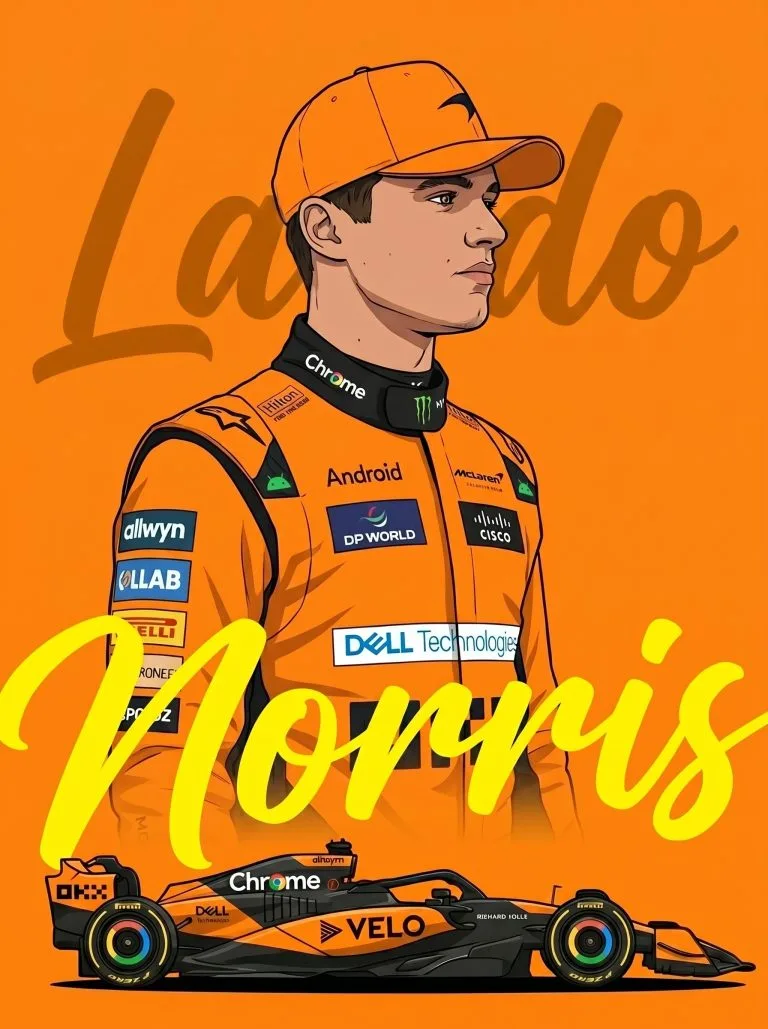
2025 Drivers' Champion · McLaren
A calculating champion whose 1976 return became one of racing's defining stories.
Qualifying speed, wet-weather mastery and an enduring cultural legacy.
The central figure in Ferrari's dominant early-2000s championship run.
A record-era champion whose influence reaches far beyond race results.
Four consecutive championships made him the defining young star of the early 2010s.
Adaptability, racecraft and longevity across several technical generations.
A defining force of the ground-effect era, known for relentless race pace.
McLaren's modern-era champion after a season decided by the narrowest margins.
Niki Lauda's crash, survival and return intensified the debate over circuit safety and driver influence.
A title-deciding collision and subsequent rulings turned an already fierce rivalry into a lasting governance controversy.
The deaths of Roland Ratzenberger and Ayrton Senna led to immediate interventions and a lasting safety programme.
A tyre-safety dispute left most of the field unable to start, exposing a breakdown between sporting, technical and commercial interests.
McLaren was excluded from the Constructors' Championship after confidential Ferrari information entered the team's organisation.
The late safety-car restart procedure drew major scrutiny and led to changes in race-control structure and operating processes.
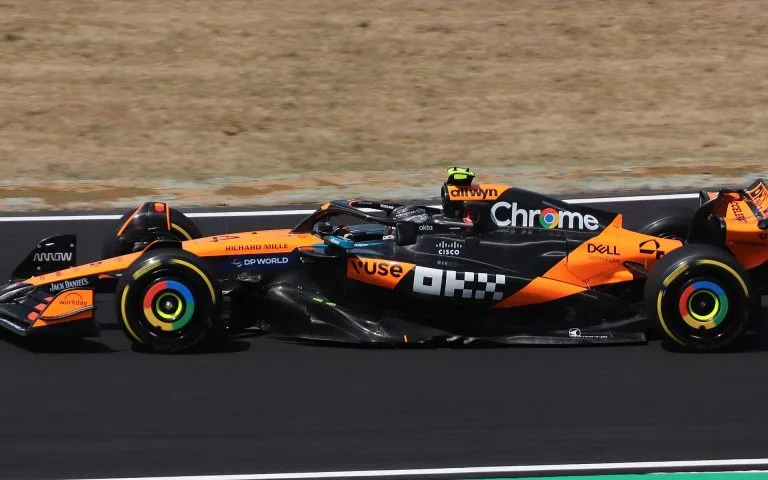
2025 Constructors' Champion · Woking, England
Formula 1 is the FIA's highest international class of single-seater motor racing. Teams compete at Grands Prix across a season for Drivers' and Constructors' championship points.
A standard weekend includes practice sessions, qualifying and the Grand Prix. Sprint weekends use a modified programme that also includes a shorter Sprint race.
Each driver scores toward the Drivers' Championship. Points from both drivers on a team are combined for the Constructors' Championship.
A Grand Prix normally covers the least number of complete laps exceeding 305 kilometres, with Monaco treated differently under the sporting rules.
Points are awarded according to the finishing order defined by the current sporting regulations. Sprint events award a separate, smaller set of points. The exact system has changed several times in Formula 1 history.
Formula 1 is a constructor championship. Every team must design its own chassis while complying with the same technical regulations, which is why engineering solutions and performance differ across the grid.
Parc fermé is the controlled period during which teams are heavily restricted from changing a car's set-up. It protects sporting fairness between qualifying and the race.
Cars slow down and form behind the Safety Car while a hazard is cleared. Pit-stop timing, track position and restart procedures can significantly affect the race.
Michael Schumacher and Lewis Hamilton have each won seven Drivers' World Championships, the shared record referenced in this guide.
Lando Norris won the 2025 Drivers' Championship for McLaren, finishing ahead of Max Verstappen and Oscar Piastri in the official standings.
Use the team grid above or visit the Kozmozracing By Team directory to open individual profiles and related collections.
No. Unless a product page explicitly states otherwise, Kozmozracing is an independent store and is not affiliated with or endorsed by Formula 1, the FIA, any team or driver.
Independent fan guide: Formats, teams and regulations can change. Verify current sporting information with Formula 1 and the FIA. Championship, team and driver names belong to their respective rights holders.
No products are assigned to Formula 1 yet. Add products to this series in the product editor.


